
General News » News
Cardinal Carter students turn Research Club into international success
August 6, 2026 · 0 Comments
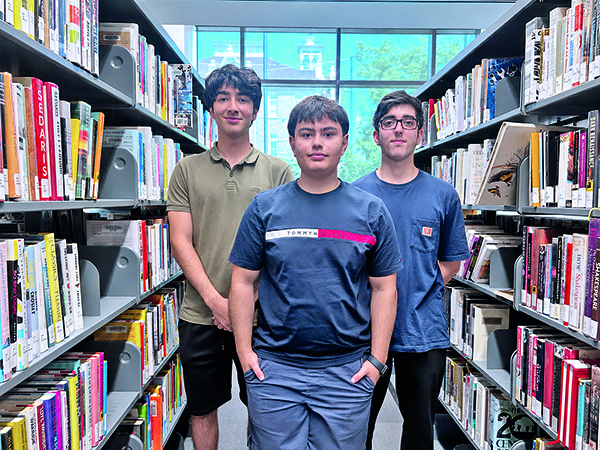
As A.I. continues its rapid rise, it’s can be harder and harder to suss out sources of real information – but a group of Cardinal Carter students have come together to help their peers hold their own in research literacy as they prepare for university, and their efforts have gone global.
Samyar Shafiee, a student at Cardinal Carter Catholic High School who is going into Grade 12 this fall, is one of three students behind the school’s Join Research club. Since its inception within the Cardinal Carter community, it has since grown to more than 300 students across five provinces and two U.S. states.
Join Research pairs students with university mentors and free workshop resources, including its free Research 101 course, which offers students the fundamentals.
Students founded the Join Research club last October under the supervision of their biology teacher. By December, they began looking at ways to scale up.
Their first stop was establishing a monthly research club at the Aurora Public Library, a component of the program that continues to go from strength to strength. From there, they went online with their Research 101 program where they felt they had the potential to reach thousands of youth looking to build their skills.
Shafiee says there are more resources and programs in the United States to help students develop their research skills and, in founding the club here at home, they were looking to close a gap.
“It’s an online forum with one single classroom where we have live sessions every day for five days a week, one hour from 10 – 11 a.m.,” he explains. “I record those sessions and post it in the classroom, so if you have a time zone mismatch, you can easily watch the videos and ask the same questions. It’s just going to be asynchronous instead of a synchronous class. It still works out as a fully online course because we don’t have the resources as a student non-profit to go to every single province physically. However, what we’re planning to do is do a research competition with the University of Toronto in the winter of 2027.
“Most of our students are interested in health science and biology, but we also have a bunch of students interested in engineering sciences and overall STEM. The whole point of the course is that we don’t dive into any content-specific information. What that means is we give you a baseline understanding that you can apply to any topic – for example, the basic skill of reading an abstract, or the basic statistics behind your data. These basic skills can apply to any sort of content. If you wanted to do a paper in history or the social sciences, you still have to go through the same process of writing, revision, being peer reviewed and all that fun stuff.”
For participants, a type of peer review can happen in real time as students are paired with one of five university members – often undergraduate students – who work with the teens to take their skills for the next level.
“If we can just spark that passion in them, they’re going to be doing more work on their own and they’re going to become great researchers on their own after the program,” says Shafiee. “We want to keep it a fun environment and the whole point is we make it as flexible as possible so anyone can fit it into their schedules…. This is just for helping around the community and in general, Canadians and all international students. That’s the goal.”
It’s a goal that has been a few years in the making.
Shafiee came to Canada when he was in Grade 8 with limited English. He quickly found he was adept at learning the language through watching English TV shows and videos on YouTube. At the end of his first year, he earned the Math Award from his elementary school which he said “gave me that little confidence boost that I can actually achieve something.”
“I went through Grade 9 and Grade 10 just trying to build the skills required for starting this non-profit,” he says. “I always had an idea that I wanted to run something at a high scale, it doesn’t matter whether it is a research organization or even a business. I just wanted to commit to a company or an organizational non-profit I could scale up by some university. From then on, I studied hard, tried to build connections with my teachers, because if I didn’t build up connections with my high school teachers, there would have never been a club to begin with and there would never have been the idea to start a research organization.
“Building these connections with people around you is the most important thing I have ever done, and that’s how it helped me excel in Canada.”
For more on Join Research, visit joinresearch.ca or email info@joinresearch.ca.
By Brock Weir
Editor
Local Journalism Initiative Reporter


Readers Comments (0)
Headline News

Break the Silence walk to mark 10th anniversary with expanded outreach
.
Victoria Hall restaurant will carry on legacy of Aqua Grill
Aurora’s Victoria Hall will soon begin a new chapter as a restaurant, peppered with the flavours many local foodies have come to know and love ...

One-hundred-year history of St. Andrew’s College in Aurora celebrated in heritage showcase
St. Andrew’s College has been dedicated to boys’ education for more than 125 years. Now, as the school marks 100 years since it moved from ...
Biondic’s inspirational life as a marathoner, ultramarathoner, and community builder stamps his ticket into the Aurora Sports Hall of Fame
After 25 years as an ultramarathoner and 20 years of experience as a marathoner, George Biondic knows a thing or two about ultrarunning. The dynamic ...