
General News » Headline News » News
Changing face of what it means to be a veteran explored at Remembrance Dinner
November 6, 2026 · 0 Comments
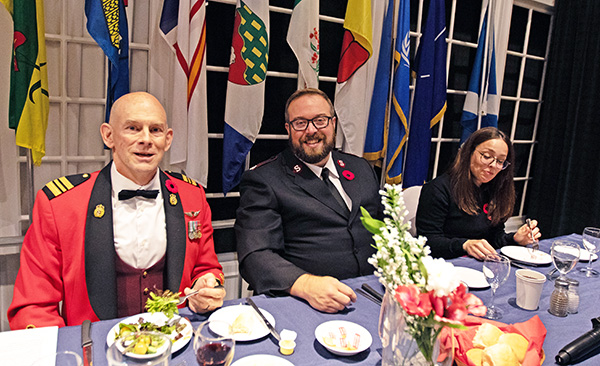
Members of the Canadian Armed Forces are put in harm’s way every day to defend our interests and keep peace around the world.
But recent events at CFB Wainwright brought home that the danger faced by these dedicated men and women can be faced at home as well, while work during what is considered peacetime can be overlooked.
These were themes touched upon as members of the community came together last week at a special dinner hosted by the Aurora branch of the Royal Canadian Legion last week to mark the start of its annual Poppy Campaign.
Aurora-Oak Ridges-Richmond Hill MP Costas Menegakis, MPP Michael Parsa, and Mayor Tom Mrakas were among the dignitaries in attendance on October 24, while members of the Legion broke bread and shared personal perspectives.
Ordinarily, it’s a dinner in which veterans of the Second World War and Korean War fill the room, but time and circumstance have made these ranks thinner than ever before, a fact reflected upon by Murray Charlton of 140 Air Cadet Squadron.
Speaking before the audience, the Cadet leader noted that he works to impress upon young people what it means to be a veteran when so many current service personnel often associate the term with soldiers of an earlier era.
“Every year at about this time I talk to the cadets and I say to them, ‘Tell me your opinion – what is a veteran?’ The response I get is astounding. They talk about their grandparents who served, whether it be in World War II, because World War I vets are no longer around and World War II vets are getting fewer and fewer [along with] Korean War vets, but they don’t think about the conflicts that we’ve had recently,” he said.
Charlton, who himself served in the Queen’s York Rangers, has a long family history in the forces, including a grandfather who served in the First World War. Charlton served in the Rangers for more than 43 years before retiring in 2019.
Now working with teens in the Cadets, he said they don’t often think about those who served in Afghanistan as veterans, but he tries to broaden their perspectives.
“I think [to] a kid a veteran is someone like their grandfather or their grandmother. I say, ‘Well, how old do you have to be to join the Armed Forces in Canada?’ The answers I get are astounding. They figure you have to be at least 20-years-old to join the Armed Forces. I say, ‘No, you can join the Armed Forces at the age of 16, providing you turn 17 by the end of the year with your parents’ permission.’
“The stunned looks that I get are astounding because they never had that idea. It never came about. I said, ‘How old do you think people [were] deployed to Afghanistan?’ They go, ‘I don’t know. 20s, whatever.’ I tell them [about] one soldier in particular that was in the Rangers who deployed before his 20th birthday. He was 19 and he went over because he could speak the language and they needed people who could do that. He also went over and did a second tour of Afghanistan before he was 24.
“We’ve got young people nowadays who are deploying to Latvia to train up all the Ukrainian soldiers that are going through Latvia to get trained up to go defend their own country. I said, ‘Think about that. Yes, your grandparents probably were involved in the service during World War II or Korea, depending on their age. Think about that: people who are as old as maybe your older siblings are deploying for operational tours.’ To me, the reckoning that you get when you explain that to do them is earth-shattering because they never thought about it. A veteran is anybody who is willing to put a uniform on and put their life in harm’s way to defend the country.”
By Brock Weir
Editor
Local Journalism Initiative Reporter
Readers Comments (0)
Headline News
Breaking the Silence can be as simple as saying “I believe you”
Yellow Brick House marks 10 years of fundraising walk
Community Reflection Space to be opened in sunset ceremony Monday
Few people welcome the early sunsets that come with setting clocks back an hour, but it will help provide a perfect backdrop for a special ...
Changing face of what it means to be a veteran explored at Remembrance Dinner
Members of the Canadian Armed Forces are put in harm’s way every day to defend our interests and keep peace around the world. But recent ...
Already in the holiday spirit? Sign up for the Deck the Halls Tour
Halloween is now in the books, and some have already turned their attention towards the holiday season. If you’ve already started decorating your home for ...