
General News » News
Historian shares thoughts on Emancipation Day with ABC, community
August 6, 2026 · 0 Comments
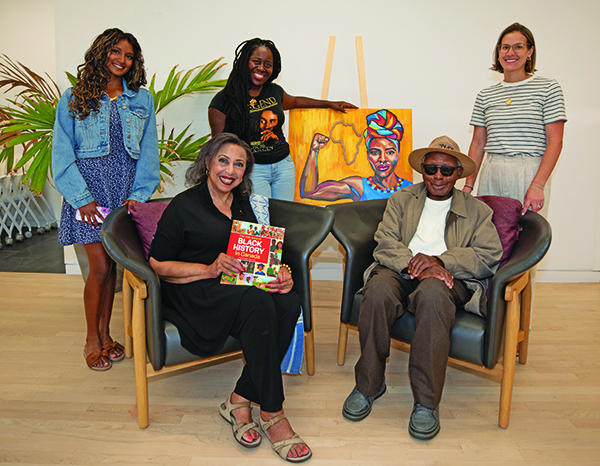
Rosemary Sadlier was instrumental in the establishment of Black History Month across Canada, but her advocacy work as President of the Ontario Black History Society increased the profile of Emancipation Day in this country as well.
As communities gathered August 1 to mark Emancipation Day, the anniversary of the abolition of slavery across the British Empire in 1834, Sadlier was at Aurora Town Square to speak on the importance of the observance to people all over the world.
Sadlier shared her thoughts in an in-person and virtual seminar hosted by the Aurora Black Community Association (ABC) and hosted by ABC founder Phiona Durrant.
“I became involved in doing Emancipation Day because I was approached by the President of the Caribbean Historical Society of Trinidad and Tobago many years ago,” she shared. “The focus was very much on the impact and significance of the British Imperial Act and [my focus was] why is it so important that at least 800,000 people were freed as a result of that?”
Sadlier is a multi-generation Canadian. Her mother’s family, she said, came to what is now Canada in 1830 via the Underground Railroad, while her father’s side of the family has heritage in New Brunswick going back to 1783.
She didn’t find out about her family’s deep roots here until she was already married and a mother of two, she said, leading her to wonder why this type of history was not taught regularly in schools. This fuelled her interest and eventual career in studying and amplifying Black history – a line of work which has given her a unique perspective on the present-day challenges facing Black Canadians.
“As a person who had grown up in this country, as a person who had children, as a person who was involved in doing Black History presentations, and I had done thousands, actually – in the process of raising awareness about the importance of Black History, how can you be a part of that and not see why you have to continue?” she said. “There weren’t as many people doing it as I might have preferred. You had to keep pushing, because it was a story about me, because it’s a story about my family, because it’s a story about my kids and who they are going to school with. How do you make that change if you yourself aren’t willing to take some of that responsibility to change it?
“When I had a platform heading the only Provincial heritage organization in this country with a focus on Black history, I felt it was important to use that as much as I could.”
More platforms exist now than ever before, however, and Durrant asked how people of European heritage can be part of that solution without concerns of “taking up space” or not having the personal lived experience to speak up.
Sadlier responded that not everyone is expected to be a “social justice advocate,” but it’s important to show up “if you are committed to seeing improvements in society.”
“If you are committed to seeing improvements in this society, and if you have children, or you want to see your tax dollars used properly in terms of what you support in terms of our school system, if you’re a voter, if you’re running for a position, you might need to have a position and you might need to do more than show up. You might need to actually commit and make yourself available to do things, but everyone doesn’t have to do the same thing. You work in the area where you have comfort and where you have skill, and you ask questions. If you’re not sure, just ask. Everyone has a space.”
At the same time, however, Black Canadians shouldn’t have to shoulder the burden of educating others.
“Every Black person is not supposed to be providing every White person with a rundown of Black history and issues related to the transatlantic slave trade,” she said. “At the same time, you have to come with some preparation. If you walk into a kitchen, you have to kind of know how to cook a little bit. You should have basic rules about what you need to do so that when someone puts a carrot in front of you, you kind of know how to peel it. You need to have some skills.
“Not everybody is going to be able to do everything, but if you’re a teacher, what are the things you can do as a teacher? What are the curricula that you can draw from? What are the ways that you can inject issues of injustice or issues of anti-Black racism, or issues that relate to making society just better in terms of issues that might be current and coming up where you are?
“If you went to school in this country, you would not learn Black history, so it’s not your fault, exactly, and the grand narrative has certainly not prepared you for the reality of what the Black community in this country is. The grand narrative is lacking, so I think we have to be open to new information. We have to be prepared to become open and curious, be willing to find out new information, and move from that.”
By Brock Weir
Editor
Local Journalism Initiative Reporter


Readers Comments (0)
Headline News

Break the Silence walk to mark 10th anniversary with expanded outreach
.
Victoria Hall restaurant will carry on legacy of Aqua Grill
Aurora’s Victoria Hall will soon begin a new chapter as a restaurant, peppered with the flavours many local foodies have come to know and love ...

One-hundred-year history of St. Andrew’s College in Aurora celebrated in heritage showcase
St. Andrew’s College has been dedicated to boys’ education for more than 125 years. Now, as the school marks 100 years since it moved from ...

Biondic’s inspirational life as a marathoner, ultramarathoner, and community builder stamps his ticket into the Aurora Sports Hall of Fame
After 25 years as an ultramarathoner and 20 years of experience as a marathoner, George Biondic knows a thing or two about ultrarunning. The dynamic ...