
General News » News
Ratepayers’ debate stirs discussion on finance, infrastructure with Mayoral candidates
October 8, 2026 · 0 Comments
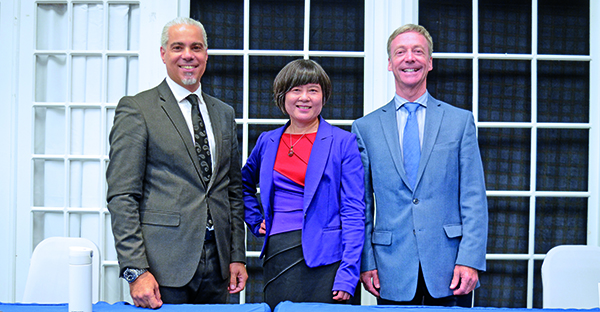
More than 120 residents filled the banquet hall of the Royal Canadian Legion’s Branch 385 on Wednesday night to hear from Mayoral candidates at a debate hosted by six local ratepayers’ organizations.
The evening was attended by all but four Council candidates who met with residents prior to the Mayoral debate, which was attended by Shawn Deane, John Gallo, and Yafang Shi. As previously announced, incumbent Mayoral candidate Tom Mrakas did not attend.
The wide-ranging discussion, which was moderated by Stephen Boyne, President of the Aurora Legion touched upon many issues – from Council cohesion, to affordability, heritage preservation, and road safety – but many looped back to common themes of municipal finances and sustainability.
Asked how each would “balance the Town’s Capital and Operating Budgets” given new rules limiting how communities like Aurora can collect Development Charges to help address costs related to growth, the three candidates agreed this uncertainty is a concern.
Deane led this discussion, slating the decision made to take $400,000 from the Town’s Tax Rate Stabilization Reserve to smooth over any financial bumps in the road.
“We’re literally subsidizing development. This has to stop,” he said, pointing to the Town’s “extremely complicated” Development Charge study.
“The Province has downloaded and pushed out their expenses to municipalities and it is extremely complicated,” he continued. “There’s been a whole movement to have the Province share 1 per cent of property or sales tax to fund the shortfall. The Province has been denying that…. so I want to create noise about this within the community and York Region.”
Gallo said he shared “a lot” of Deane’s concerns, stating the Province’s moves on Development Charges have created significant uncertainty and continues to be a “moving target” for municipal staff.
“We have to strategize ways to figure out how to deal with those shortfalls,” said Gallo. “In terms of capital plan spending, I have some serious concerns, and you may remember a few projects that we’ve completed – Victoria Hall, Town Square, and in the past, the Joint Operations Centre. [The] Joint Operations Centre started at $16 million, ended up at $35 million. The Town Square started somewhere around $30 million, ended up at $60 million with a $6 million overflow. We all know Victoria Hall, $500,000 to $2.2 million. Those types of things have to stop.
“In terms of the Town Square, I was not supportive of it, simply because normally those big projects are funded one-third from the federal government, one-third from the province, and one-third from us, and that didn’t happen. Once that funding model went away, I couldn’t support that project.”
Funding shortfalls were also cited by Shi, who said this issue needs to be addressed by the next Council “carefully and responsibly.”
“According to the long-term asset management funding strategy report from June 2026, staff has recommended phasing in the required levy increase for asset management over the next Council term before making decisions that will affect residents and taxpayers. I believe the new Council needs to take a close look at the details behind this funding shortfall,” said Shi. “We need to understand exactly where the gap is coming from, why it has developed, and what assumptions are being used to determine the Council’s future funding requirements. My goal is to maintain quality, accessible services and programs that contribute to a healthy, vibrant community while managing the finance responsibly.
Focus was maintained on finances in the next area of discussion, which zeroed in on how each candidate would prioritize infrastructure spending to make sure it keeps pace with growth.
Gallo was the first to answer this question, stating it was a “complicated question” and said it was the role of the next Council to “take the lead from our very capable staff, our Director of Finance, to figure out solutions, to come to Council with suggestions, analyze those suggestions, and make informed decisions on how to address them.”
“In terms of budgeting and finance, there are two immediate things I would do: first off, we’re going to make sure that one person does not approve a $200 million budget,” said Gallo, referencing Strong Mayor Powers handed to communities like Aurora by the Province of Ontario which, among other factors, has made municipal budgeting the Head of Council’s purview. “Second, we’re going to go back a little bit in time, particularly that we know there will be…at least four brand new Councillors on Council. We’re going to take it step by step, the budget process. I remember a time many hours on many Saturdays that we were in the Council Chambers, going line by line by line. I think that’s an appropriate step to take with brand new faces at the Council table, including for myself. Let’s re-assess and let’s have a really good understanding of our budget process and take whatever time it needs.”
Deane said keeping pace with growth in the face of aging infrastructure is “core” to his platform. Without a “solid grasp of your finances” you can manage neither assets nor growth, he said.
“Growth does not pay for growth. Council knows this, and instead of trying to correct it, they’ve accepted it. This is unacceptable. So, how do we fix this? We have predictable funding from the provincial and federal government every year, and we also have predictable funding from tax relief and grants,” he said. “We need to budget better, is simply what needs to happen. We’re spending more money than we bring in. Who does that at home? Who do you hold responsible when someone’s overspending? We’re spending way too much on growth and new, and then trying to understand why we can’t keep pace with growth and services this year have suffered.”
Infrastructure for new development projects, added Shi, should continue to be paid through Development Charges, but the present situation presents possible opportunities for change.
“The intensification will occur along the Aurora Promenade, the Aurora GO Station Major Transit Station Area, and the Regional corridors and local corridors,” said Shi. “This approach to growth provides an important opportunity to strengthen our public transportation network and reduce our reliance on cars. We should continue to strengthen connections to GO transit, improve local bus services, and make Aurora more accessible for people who choose to walk or cycle. If elected, I would advocate for better GO transit services.
“This is about more than reducing traffic. Better public transportation can improve accessibility, support our environment, and make our community more connected and livable.”
In a further question touching on the topic of sustainability, candidates were asked in the face of “three pillars of sustainable development [being] social progress, economic growth, and environmental protection and enhancement” to outline their visions to “ensure sustainable development in Aurora.”
“Aurora is growing, and the planning decisions we make today will shape how our Town looks, functions, and feels for generations to come. That is why I believe we need to plan thoughtfully and carefully,” said Shi. “When we consider new development, we need to look at the whole community. That means consider our diverse housing needs, residents concerns, infrastructure capacity, environmental protection, and heritage preservation.
“Growth should not be simply about building more homes. We need to make sure that our roads, transportation system, water and wastewater infrastructure, parks and community services are ready to support that growth. We also need to listen to residents who live in the community where development is taking place. Their experiences and concerns are important to good planning. At the same time, we must protect Aurora’s natural environment and heritage. Climate change also needs to be part of our planning decisions. The Town of Aurora has set a goal of achieving net-zero greenhouse gas emissions by 2050 with both corporate and community-wide reduction targets. We need to think about climate adaption and resilience when we build and renew our infrastructure. Our infrastructure should be designed to better withstand extreme weather, protect our environment, and serve our community over the long term.”
As an incumbent member of Council, Gallo said the Town has a “variety of plans to deal with sustainability,” including through the Town’s Official Plan and various environmental plans.
“Ultimately, it’s a question of implementing these plans in a meaningful way, executing on them collaboratively amongst Council,” he said, paying tribute to outgoing Councillor Wendy Gaertner for her environmental advocacy. “The next Council will have to be brought up to speed on all those plans and bring them into fruition.”
While Deane said he believed sustainable development “is a great concept,” it can be very costly when tied to a budget – whether it’s a municipal budget or a household budget.
“I believe there is a lot that we can do to protect the environment that costs nothing, and that’s changing our behaviours at home. There’s Climate Action Newmarket-Aurora’s website that has an exhaustive list of simple things we can do to protect the environment by changing our ways. I’m all for the concept of investing in the environment, sustainable buildings, etc., once we consider the return on investment,” he said. “If the return on investment doesn’t make sense, especially now in this economy, then it would be very hard to justify.
“We have also headwinds. The little bit of an impact that we can make between now and 2050 to go to net zero is going to be undermined by the forces of our economy, which are promoting data centres, Bitcoin, the exploitation of our own natural resources, and adding 8,000 new homes in Aurora. How does that protect the environment?”
Last word went to Shi, who said spending “responsibly” is key, but it’s also important to look beyond budget line-items.
“If your own concern is about the budget, it’s very short-sighted because we are facing climate change. If we do not invest, if we do not build up the adaptation and resilience you will pay more in the future. When we make decisions, we cannot only make those short-term decisions to please sone residents. We need to think for long-term, for long-term interests, for generations to come.”
By Brock Weir
Editor
Local Journalism Initiative Reporter


Readers Comments (0)
Headline News

Future in focus as Mayoral candidates share ideas at Library event
.

National Day for Truth & Reconciliation gathering urges standing in solidarity in the face of denialism
True restitution would be the ability to bring back “every single child that was murdered, starved, raped and killed” in Residential Schools, says Traditional Anishinaabe ...
Start Thanksgiving in style with outdoor music and “Fall Faves”
The Thanksgiving Long Weekend is here, and there are plenty of ways to get a head-start on seasonal fun in Aurora. The party is set ...

Aurora Sports Hall of Fame’s Class of 2026: AMHA President Joe Bentolila
After enjoying an Alaskan cruise and copious amounts of King Crab last week, Joe Bentolila is the picture of relaxation at our booth at Wicked ...


