
General News » Headline News » News
Future in focus as Mayoral candidates share ideas at Library event
October 8, 2026 · 0 Comments
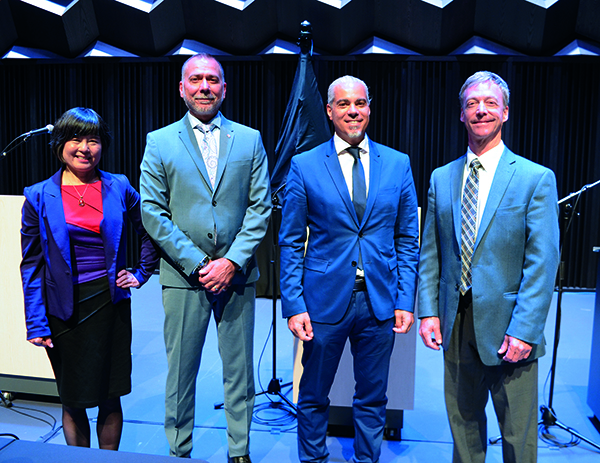
The future of Aurora was in focus on Sunday afternoon as all four of the Town’s mayoral contenders participated in an all-candidates meeting hosted by the Aurora Public Library.
The event, which was held in the Aurora Town Square Performance Hall and moderated by Deanne Kukulewich, Executive Director of Rose of Sharon Services for Young Mothers, was preceded by an opportunity for residents to meet with each Council and Trustee candidate at stations set up throughout Aurora Town Square.
Back in the Performance Hall, each Mayoral candidate was allocated a four-minute opening statement, each Council candidate a two-minute introduction, and each Education Trustee one minute to introduce themselves.
After opening remarks, the question-and-answer round for Mayoral candidates followed, with eight questions randomly selected from submissions made by Library patrons and the community at large.
The first question, posed by Tiffany Y., questioned whether the Town should install a signalized intersection on St. John’s Sideroad and Old Yonge Street, an area they said “can be inconvenient and dangerous at times” for area residents.
First to answer was Yafang Shi, who said it’s a concern the incoming Council will need to look at with Regional input.
“I met with the ratepayers’ association there. They raised this question and I think we should look into the details and try to find solutions to address the residents’ concerns,” she said.
Incumbent Tom Mrakas said the simple answer to the question was “yes,” adding that it’s an option that has been explored by the Region and Municipality for “quite a bit of time.”
“[The Region] put forward the pilot – that is what’s in place at this moment of time. Once we’re done, which is supposed to be coming up in six months, we’re going to go through the data that allows us to look at whether we’re going to continue with the pilot, or make some modifications, which also include looking at signalized intersections,” he said. “I hope that we do move forward in that direction.”
John Gallo agreed that safety was a concern at the intersection, but expressed some reservations that signalization was the right path forward given its proximity to the already-signalized intersection at Yonge.
“Whether it’s putting lights there or not, it’s a Regional road, it’s very close to Yonge Street. I think we have to explore the best option for that intersection,” he said. “I’m not convinced that lights are the best option for that, considering how close it is to Yonge Street, but I would be open to looking at all options.”
The intersection has been “problematic for a while,” agreed Shawn Deane, who added that incoming developments in the area will “exacerbate” the issue.
“Part of proper planning would have had these studies done in advance to know before approving a development whether or a traffic light should be there or what the other solutions are,” he said. “Staff and all the consultants that we invest in are best suited for this, and there just needs to be some better planning in advance to avoid this problem when developers are already approved to begin.”
The environment was a top concern for resident Shirley J., who asked each candidate to outline “concrete steps” they would take to restore the environment, combat invasive species and safeguard water quality given Aurora’s proximity to the Greenbelt.
Mrakas responded that “protecting our environment has always been top of mind” for himself and Council and that is reflected in policies embedded into the Town’s Official Plan to “make sure that any development occurs with making sure we protect the sensitivities of the environment surrounding us.”
“Anything in the Greenbelt is a no-go, anything in our Oak Ridges Moraine Countryside is a no-go. It’s been like that for a long time [and] will continue to be like that, and I’ll make sure that we continue to uphold all our environmental standards within our community any time and all time,” he said.
Gallo responded that the environment is a “huge part of my belief system,” and reflected in his work on Aurora’s Environmental Advisory Committee and on the David Tomlinson Nature Reserve.
“I’m a huge proponent of maintaining our tree canopy at 40 per cent and we just have to continue to do the great things that we’ve already done in Aurora,” he added.
Next to answer was Deane, who said that while the environment “is worth fighting for,” Aurora is not the only decision-maker.
“Provincial mandates can declare an economic zone at any given moment and override where development happens,” he said. “The other environmental concern is with the 8,000 houses, a 40% increase in our population coming to Aurora, that does not protect the environment. So, what we need to do is make sure this is responsible growth that everyone talks about, and right now, 8,000 home mandates where we haven’t built 1% of our targets is a concern.”
Shi was last to answer this question, stating her vision for Aurora “is to build an inclusive, sustainable, vibrant and thriving community.”
“I think Aurora is growing fast and…we have to plan thoughtfully and we have to consider all the factors – housing needs and residents’ concerns, infrastructure readiness, and environmental protection and heritage preservation,” she said.
Population is not the only thing set to grow in Aurora. Metrolinx’ plans to significantly increase rail service on the Barrie GO line in the coming years, a corridor that bisects the community, was also a concern, with Holly A. asking each candidate to weigh in on future GO service and its impact on Aurora.
“We’re going to be having a serious problem when all the trains are active,” said Gallo. “They proposed 15 minutes every day there to Union. I think they’ve cut that down since then. Notwithstanding that, the main east-west corridor of Wellington is going to be an absolute disaster if Metrolinx and the province does not fund an underpass at that location, and I will be advocating [to] Metrolinx and the Province and anyone I can get in front of to make sure that’s back on the docket and it’s done.”
Traffic in the GO Station area has been an issue for “a long time,” said Deane, and once again said population growth was going to exacerbate the issue.
“There’s an opportunity that’s been missed here with negotiating with the province with that pledge of 8,000 homes. If we’re going to be mandated to pledge or build homes, that would exacerbate the traffic problem, and it’s really incumbent upon the province to resolve that issue,” he said. “Additionally, the ticket sales and the property tax revenue from the GO station, we don’t receive that. That’s what should be funding this, not local taxpayers.”
A similar view was offered by Shi, who cited approved condo builds for the Major Transit Station Area, adding: “I think we can think more proactively. Maybe this creates opportunities for us to strengthen public transportation.”
Mrakas responded by saying “dealing with Metrolinx is like pulling teeth” but talks have been had at upper levels of government.
“We know that York Region has to put in their fair share when it comes to the grade separation at Wellington. That’s why I’ve pushed my colleagues at York Regional Council to approve funding to come through our development charge by-law to see developers pay for that grade separation, not the taxpayers, so that’s coming,” he said. “Once the traffic study is done by Metrolinx, we can begin to move forward with funding from the province, as well as from York Region and the developers.”
Transit concerns made way for financial concerns, with another question from Shirley J., who asked each candidate to identify their “top three factors contributing to budget overspend on capital projects,” and what each would do to address the issue.
“Setting budget limits is what’s missing,” responded Deane. “At the start of this year, our budget and the capital budget for all these projects did not have a limit. We were only supposed to spend $25 million. We spent $65 million, and we rolled into February with staff asking for an extra 350% increase on the Victoria Hall project because they failed to complete it. They did the same the following month with a 50% increase on the multi-use path. So, setting budget limits, holding, bringing that information into [Council Chambers] when we’re having project budget meetings, holding staff accountable for communicating the information where they’re at with respect to the budget limit, and what we’re going to cut from the budget if they’re intending to go over budget. This is what’s missing.”
Shi said it’s an issue of “how to choose the projects,” paying particular focus on renovations to Victoria Hall approved by Council earlier this year as one example.
“Is this money well spent? I think those heritage buildings should be reserved for community purpose, and we should not spend money on renovations for commercial use like a restaurant inside our heritage buildings,” she said.
In answering the question, Mrakas drew the attention of audience members to their surroundings at Aurora Town Square.
“We always hear about increased costs. We have to remind ourselves that we approved this during COVID,” he said of the Town Square build. “If we didn’t approve it during those COVID years, the estimate on this project would have been well over $90 million in another municipality. So, it was the right decision at the right time. But we continue to put project management in front of all of our capital projects that we move forward to make sure that we really look at efficiencies and where we can make sure…that we’re not running over-budget and make sure that we come in on time. These are important factors that we’ll continue to do to strengthen our relationships with the project management team and continue to provide fiscal accountability to every single project in our Town moving forward.”
Gallo, however, offered a different viewpoint, stating he would put the municipal budget back into the hands of Council as a whole, rather than with the Mayor’s Office, which is now the case under Strong Mayor Powers.
“We have to spend a lot more time on how we budget, even if it’s a line by line, particularly our capital budgets,” he said. “You know, we cannot continue to have these capital projects skyrocket in price for no apparent reason and not be transparent when we do it and then have a majority of Council pull them through. Victoria Hall comes to mind immediately. A total change in how we conduct our business with regards to budget.”
NEXT WEEK: Mayoral candidates address wedge issues, data centres, ensuring Aurora’s east side is well-serviced, and where municipal responsibilities stand compared to upper levels of government.
By Brock Weir
Editor
Local Journalism Initiative Reporter


Readers Comments (0)
Headline News

Future in focus as Mayoral candidates share ideas at Library event
.
National Day for Truth & Reconciliation gathering urges standing in solidarity in the face of denialism
True restitution would be the ability to bring back “every single child that was murdered, starved, raped and killed” in Residential Schools, says Traditional Anishinaabe ...
Start Thanksgiving in style with outdoor music and “Fall Faves”
The Thanksgiving Long Weekend is here, and there are plenty of ways to get a head-start on seasonal fun in Aurora. The party is set ...

Aurora Sports Hall of Fame’s Class of 2026: AMHA President Joe Bentolila
After enjoying an Alaskan cruise and copious amounts of King Crab last week, Joe Bentolila is the picture of relaxation at our booth at Wicked ...


