
Arts and Culture » General News » News
Local history in “Focus” – but “unFRAMED” – in new photography exhibition
July 16, 2026 · 0 Comments
A bouquet of flowers, a bottle of a favourite libation, your signature dessert – there is no shortage of options these days on host gifts – but, more than a century ago, if you really wanted to wow your hosts and show that you were keeping up with the latest tech, the carte de visite was the way to go.
Cartes de visite were hardback photographic portraits people often left as a memento of their visit, or as a calling card for a visit-to-come.
It was one of the first forms of truly popular accessible photography and was embraced the world-over – including Aurora.
A selection of these cartes de visite are now in the spotlight at Aurora Town Square as the Aurora Museum and Archives hosts “Aurora Through the Archives: [un]Framed and In Focus,” part of the Ontario-wide CONTACT Photography Festival.
The Aurora Museum and Archives is a long-time participant in the Festival, and this year they decided to, quite literally, focus on a selection of images that might be small in number, but big on historical impact.
“Cartes de visite is a photography form that was devised in the 1860s, quite early in the history of photography, but didn’t really make it into Canada as a popular format until the 1870s,” says Jeremy Hood of the Aurora Museum & Archives. “Because of the history we have with newspapers and other resources, we have been able to lock down when some of these photographers were performing this kind of photography and producing this form factor, which is about a two-and-a-half inch by four-inch card on thickened cardstock, and sometimes stamped with the photographer’s name – and sometimes, if you’re lucky, hand-inscribed with the subject’s name later on.”
It’s on this front the Aurora Museum & Archives wasn’t so lucky as few sitters were so identified, but the information they were able to track down on the photographers themselves tell stories all their own.
Bogart & Robinson Photography was one such studio. Although Hood says they were only in business the better part of a year, they immortalized a clear “snapshot” in time for the Aurora community.
“Even just for the couple of years that these photographers were in business, there’s quite a large variety of stamps that appear on the front and the back of these cards,” says Hood. “Trying to track down the process by which these cards were produced ahead of their use by the photographer, or whether the photographer was perhaps printing them themselves in-house, even to the point of there being printing errors on them, has become kind of a little bit of an obsession.
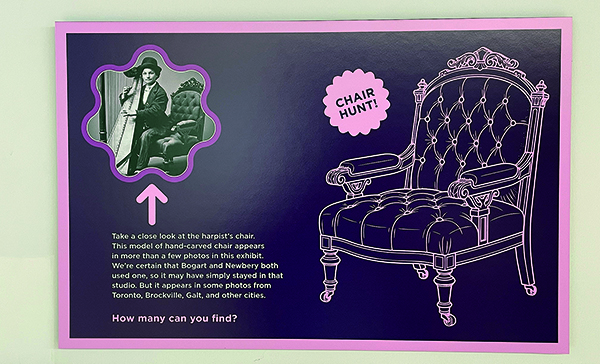
“We also have something [in the exhibition] we’re calling ‘the Chair Hunt’ because we’ve discovered this one particular carved upholstered chair which appears in a really large number of these photographs – and not just Bogart & Robinson, but also some photographers outside of Aurora in Toronto, Brantford, Galt, and Newmarket. We’ve developed a little bit of an interest in whether or not this chair is part of a set, unique, or something that a number of photographers purchased out of a catalogue. We’ve encouraged viewers here to try and find the number of instances of this particular chair – it may sound a bit silly, but it’s really striking to see this chair in so many different photos, with so many different sitters, in so many fantastic Victorian outfits. If anybody has anything that we don’t know, we are completely happy with saying, we don’t know, and please let us know. We’re always on the quest for knowledge, and we always start from our position of unknowing and move to the position of knowing, if we can. We’re completely happy to be educated on any topic that somebody has information on for us.”
While the Museum team’s collective eyes have been caught by the chair, they’ve also been dazzled by the Victorian fashions depicted on the cards, and what they’ve been able to piece together about some of the sitters.
“One [sitter] was Caleb Swayze. In looking him up, we discovered that he actually, later on, became an inventor,” says Hood. “He invented a thread-locking substance, which is not unlike the modern Loctite, but it had egg whites as its binder. He was granted a US patent in 1893 for this Loctite substance. It’s interesting to see that these people who were photographers, the amount of time that they would spend with chemicals, and with some of these more involved processes in the 1870s, in the 1880s especially, brought them into this interesting milieu, where they would have to have quite a great base of knowledge, and probably be rather curious and capable people. Caleb Swayze certainly exemplifies that.”
Aurora Through the Archives: [un]Framed and In Focus will be on display throughout Aurora Town Square until August 22. For more about the CONTACT Photography Festival and Aurora’s participation in it, visit contactphoto.com/festival/2026/open-call/aurora-through-the-archives-unframed-and-in-focus.
By Brock Weir
Editor
Local Journalism Initiative Reporter


Readers Comments (0)
Headline News

Future in focus as Mayoral candidates share ideas at Library event
.
National Day for Truth & Reconciliation gathering urges standing in solidarity in the face of denialism
True restitution would be the ability to bring back “every single child that was murdered, starved, raped and killed” in Residential Schools, says Traditional Anishinaabe ...
Start Thanksgiving in style with outdoor music and “Fall Faves”
The Thanksgiving Long Weekend is here, and there are plenty of ways to get a head-start on seasonal fun in Aurora. The party is set ...

Aurora Sports Hall of Fame’s Class of 2026: AMHA President Joe Bentolila
After enjoying an Alaskan cruise and copious amounts of King Crab last week, Joe Bentolila is the picture of relaxation at our booth at Wicked ...