
General News » News
Meditations on grief and memory come to Cultural Centre in new exhibitions
August 6, 2026 · 0 Comments
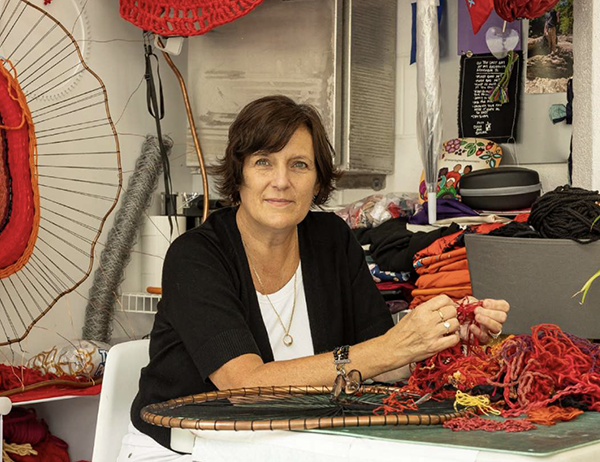
Meditations on grief and memory are bound for the Aurora Cultural Centre this month as two acclaimed Canadian artists bring powerful new installations to the community.
Up first is “They are loved – an epidemic of grief,” by Tracey-Mae Chambers, a prominent textile artist who previously installed a work at the Aurora Family Leisure Complex and hosted by the Centre.
This new work by the Metis artist, an evocative look at the lives lost to the opioid crisis, came after Chambers lost her own son to overdose in 2023.
“She was trying to figure out a way to speak with her work about mental health and addictions, and she came to start considering textiles and their ability to represent people and also their comforting effect,” says Ashlyn Gregory, Gallery Manager for the Aurora Cultural Centre. “Using textiles that have been donated from families who have experienced loss in the opioid crisis in Canada, she started making this body of work. It consists of the donated textiles, which she seam-rips and then ties together to create this sort of cellular structure and this structure is meant to represent a saguaro cactus skeleton, all about the strength that is still there even when the plant dies.
“It was a shape that she and her son encountered together on a trip to Arizona and it ties all back to her relationship with grief and her son.”
Gregory first saw “They are loved – an epidemic of grief” at Artist Project in Toronto and said she was greatly moved by the installation and the way it tells stories of the individuals represented, and also its ability to be a springboard for conversation.
The exhibition will open to the public at an opening reception set for Thursday, August 13, from 6.30 to 8.30 p.m., and will run through November 15. On Monday, August 31, Chambers will speak at an event hosted by the Cultural Centre and CAYR Community Connections, a York Region-based organization specializing in support for people who use substances, are living with HIV or Hepatitis C, or have lost a loved one to HIV or Hepatitis C.
“It’s a beautiful way to represent something that is so hard to talk about, and what a great way to get people to talk about it using art and creating a piece that is so dynamic and completely changes the space,” says Gregory. “It’s a really moving, beautiful work.
“[The artist] is also welcoming donations from families who have lost a loved one, and if people would loke to donate a textile, and she has a catalogue of textiles she has collected for people who maybe don’t have a textile to represent their loved one, they can reach out if they would like to be involved.”
As different textiles from different backgrounds come together to tell a common story in Chambers’ work, local artists are also bringing together different materials to tell stories of their own in a new exhibition in the Aurora Cultural Centre’s Great Hall Gallery. Also opening on August 13 as part of the Centre’s fall reception, and running through November 15, this exhibition of works from seven York Region Artists.
“The Collage exhibition really came to be just because I’ve been noticing trends at art fairs and different things in the cultural scene that collage is really making – maybe ‘comeback’ is not the right word as it’s always been there, but there’s sort of a resurgence in the amount of collage that I’m seeing,” says Gregory. “It’s such a dynamic practice because you’re taking bits from something else and bringing them together to create an entirely new artwork. It’s a great way for people to work through their understanding of themselves, identity, self-perception, by bringing different pieces together to create a collage of lived experience and cultural influences to explore identity.”
This is a theme that extends to the next exhibition, “Arnie Lipsey: Past. Tense.”
This show, which runs August 27 – October 31, draws on family photographs which Lipsey re-interprets into “fantastical compositions that bring into focus the cultural, historical, and personal circumstances that linger beyond the frame.”
“Suspended somewhere between the now and then, Arnie Lipsey’s narrative portraits navigate the porous spaces between inherited memory and imagination,” says the Centre. “Using painting to trace a family history shaped by immigration, trauma, and silence, the artist leans into the surreal to bridge a gap between what is remembered and what can only be imagined.
“As a second-generation Jewish Canadian, Lipsey paints from a position of ‘postmemory’ – a term that describes the ways in which the trauma of previous generations is internalized through stories, images, and cultural memory. His parents, European Jews who immigrated to Montreal before World War II, escaped Nazi persecution but lost many relatives in the Holocaust.
“Through complex symbolic language and unexpected juxtaposition, Lipsey’s work reveals the interpretive layers through which family narratives are continually re-imagined.”
Hailing his “beautiful narrative portraits,” Gregory says the Centre is always looking to tell stories of diverse perspectives from many cultures.
“Although his work is very specific to him and his experience, I think everyone will be able to see themselves in his portraits and their own relationship with family and inheritance,” she says. “Arnie has a really interesting process for how he creates his works. He works from black and white photographs of his family. He has boxes of these old photographs, and when he’s wanting to paint, he goes through them and finds a photograph, and then he fills in the background and the composition with fantastical elements that are surreal, that help tell the story, giving the photograph context, like what was going on in his family at the time. Through this symbolic language and the surreal juxtaposition, he reveals the layers of family narrative, so what he remembers, what he has been told, and how he fills in those gaps. It’s really complex, very intriguing work.
“I think people will walk away thinking about their own family history and how it’s been mediated throughout the years, thinking about things that your grandparents have told you, your parents, and then how you internalize them based on your own experiences.”
Lipsey’s exhibition will open to the public on August 27, with an opening reception open to the public from 6.30 – 8.30 p.m. The Aurora Cultural Centre will also host In Conversation with Arnie Lipsey on Wednesday, October 28, hosted by Gregory.
For more information about these and other upcoming Aurora Cultural Centre gallery exhibitions and associated events, visit auroraculturalcentre.ca/upcoming-exhibitions.
By Brock Weir
Editor
Local Journalism Initiative Reporter


Readers Comments (0)
Headline News
Break the Silence walk to mark 10th anniversary with expanded outreach
.
Victoria Hall restaurant will carry on legacy of Aqua Grill
Aurora’s Victoria Hall will soon begin a new chapter as a restaurant, peppered with the flavours many local foodies have come to know and love ...

One-hundred-year history of St. Andrew’s College in Aurora celebrated in heritage showcase
St. Andrew’s College has been dedicated to boys’ education for more than 125 years. Now, as the school marks 100 years since it moved from ...
Biondic’s inspirational life as a marathoner, ultramarathoner, and community builder stamps his ticket into the Aurora Sports Hall of Fame
After 25 years as an ultramarathoner and 20 years of experience as a marathoner, George Biondic knows a thing or two about ultrarunning. The dynamic ...