
General News » News
Town arborists encourage residents to request replacement trees for boulevards after microburst damage and ash tree removals
October 1, 2026 · 0 Comments
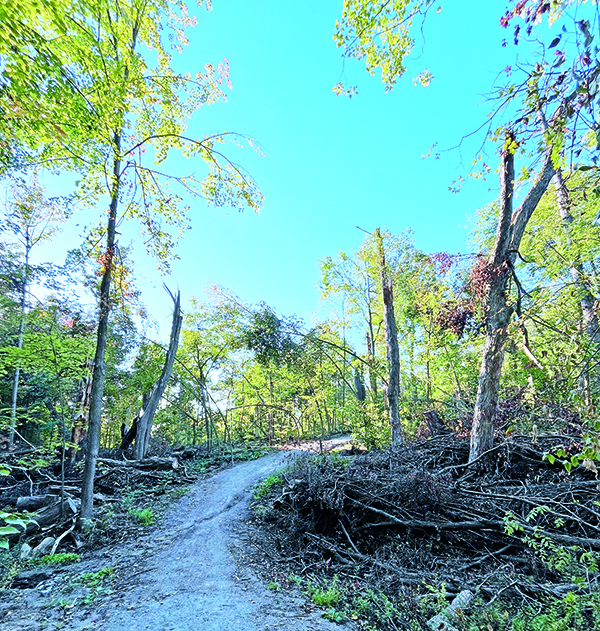
Town of Aurora arborists Ian Bryant and Cameron Chisholm are looking forward to productive and restorative Fall projects after an especially troubling and challenging Summer.
Over 1,000 trees, including 107 on Town boulevards, were destroyed in northwest Aurora during an early-July microburst that delivered 160 km/h winds and fifteen minutes of climatic chaos.
Millions of dollars of property damage, caused by falling trees, was incurred by residents who live in the leafy Bathurst and St. John’s Sideroad neighbourhood that includes St. Andrew’s College. Equally disconcerting was the sheer volume of trees that were uprooted or severed, or had to be removed by crews due to dangerous hanging branches.
Bryant, the veteran Forestry Crew Leader whose team has spent the last 89 days cutting down damaged trees and clearing debris from boulevards, parks, and the Town’s revered trail system, provided a progress update.
“All trails have been opened, except for the section behind St. Andrew’s College,” he said, noting extensive damage in the area. “The opened trails still have debris at the sides. A significant concern is all the storm debris is limiting regeneration. We’ll be steadily removing the debris into next year. As well, we’ll be removing all unsalvageable trees off the boulevards, cutting down dangerous hangers, and grinding stumps. On private properties and on the trail systems and parks in the northwest quadrant including St. Andrew’s College, easily over 1,000 mature trees are down due to that storm on July 3. Stump grinding the storm-affected trees will happen in the Fall and planting will be done in the Spring. It gives us more variety of choices for planting a variety of trees.”
Chisholm, a registered botanist who has been working for the Town for almost two years, recommended a range of trees he’d prefer to see planted on the boulevards to ensure biodiversity: “I’d like to see a combination of trees. Sugar Maple is one of my favorite trees, although some varieties don’t do as well in urban environments. Another favorite is the Kentucky Coffee Tree. They remain small for two years, but take off in size and are exceptionally tough trees that deal well with road salt and drought. Catalpas are great additions with their beautiful white flowers, but they’re a bit messy, much like the Kentucky Coffee Tree. Both have lots of seed pods which require some cleanup, but I like the messy trees. I also like the hardiness of the London Plane Tree which is part of the Sycamore family.”
Bryant augmented his colleague’s choices with trees that have a fast growth rate for residents looking to replenish their property’s green space quickly.
“Some options we can plant are Silver Maple—we have a seedless one available with a stronger central leader so there’s not as much sprawl. Freeman Maple, which is also seedless, and has Silver Maple and Sugar Maple genetics; a Tulip Tree, which is a maple-looking tree with tulip-shaped flowers; and an Accolade Elm, which is a hybrid tree—a combination of American and Asian Elms—which is immune to Dutch Elm Disease. We have a list of 30 trees. We’ll entertain a range of tree choices as long they make sense. The most popular tree we’ve been planting based on requests has been the Freeman Maple. We rely on residents to water the tree in its first year so we’re happy to support homeowners’ choices since they feel more connected to the tree that they’ve chosen and will tend to take better care of it.”
When asked if the Town would plant a Red Oak on the boulevard to replace an Ash, Bryant acknowledged his team’s willingness to plant Red Oaks, but offered options due to recent botanical research.
“Regarding the Red Oak, we can plant that for you. However, in my experience in Town, especially on the boulevards, the Black Oak family, with its pointy lobes, doesn’t fare as well as the White Oak with its rounded lobes. The White Oak family is also a bit more resilient to an emerging pathogen called Oak Wilt, which has been moving up from The States and recently identified in Ontario. Options in the White Oak family include White, Bur, and Swamp Oak varieties. We’d be happy to plant the Red Oak for residents if that is the direction you would like to go. The biggest hurdle our trees face is being watered in the first season in the ground. All Oaks and Tulip Trees require Spring planting so our crews would not put these species in the ground until Spring 2027.”
Both Bryant and Chisholm are united in their call for residents to call the Town and request one of thirty varieties of trees to replace those lost on Town boulevards. They want to restore Aurora’s enviable urban canopy that covers over 29% of the town and add to it through various initiatives available to local residents.
Bryant offered insights into “Your Leaf”, a federal program that can be viewed at www.yourleaf.org, which defrays the cost of planting saplings or seedlings on private property.
“It’s a government-subsidized backyard planting program in York Region that many residents have utilized and found to be useful. The trees start small, but you get an arborist visit and the consulting fee comes off your planting cost. They only plant native trees, and sugar maple is definitely on their planting list, if that’s what you want to replace your lost trees with.”
In addition to this federal program to plant trees as an active response to the perils of climate change, Chisholm explained the scope of the damage to the Town’s canopy. He encouraged local residents to replace trees which have succumbed to disease, windstorms, or just old age: “There’s a lot of light in the forest. As we walked through the debris caused by the microburst, we noticed how much open sky is seen through the affected canopy.”
It’s evident that both arborists derive much satisfaction from their work and Bryant noted that “When I’m driving around Town, I see the trees I planted five to ten years ago. They’ll be here long after I’ve gone. We have a lot of unique moments as a crew, too—great moments in nature. The funniest thing about some of the people we meet is they want us to plant the biggest tree and they think that trees don’t die. The most successful tree that we plant starts as a small one.”
Chisholm’s insights into making a difference to the Town’s urban canopy merged with Bryant’s.
“I share the same kind of satisfaction with Ian. Being able to get out and perform routine maintenance on the trees is like a playground for me. You can go back and see the positive effects on the tree. It’s gratifying to see your impact.”
Complementing the message of his colleague, Bryant encapsulated the selflessness of planting trees: “The true meaning of life is to plant trees, under whose shade you do not expect to sit.”
With a message as poignant as Jean Giono‘s The Man Who Planted Trees (1953) and as timely as the hard-edged conservation strategies in Dave Foreman’s Confessions of an Eco-Warrior (1991), Bryant’s appeal to leave a leafy legacy is food for thought for residents who want to make a difference in a world in dire need of environmental stewardship.
For more information about getting new trees planted on town boulevards, contact The Town of Aurora at 905-727-3123 and leave messages for Ian Bryant and Cameron Chisholm regarding your choices.
(Speaking from personal experience through my own request for three new trees on boulevards spanning Storrington Gate and Tribbling Crescent, Bryant’s email response provided timely insights and sage advice on how to restore the beauty of the boulevard with a menu of trees best suited for urban conditions. Our stately Ash trees on Storrington, which we watered as saplings in the early 1990s, but succumbed sadly to the Emerald Ash Borer, will be replaced in the Spring with a White Oak and a Freeman Maple. A new addition on our north Tribbling boulevard will be an Accolade Elm. As Swedish biologist and conservationist Carl Linnaeus remarked over three hundred years ago, “If a tree dies, plant another in its place.”)
By Jim Stewart
Local Journalism Initiative Reporter


Readers Comments (0)
Headline News
Welcoming Arms celebrated for 20 years of community support
.

Audacity North aims to bring locally-grown solutions, innovations to the world
It took seven years for Keith Loo and his wife, Mila, to get a proper diagnosis for their son, Logan, who lives with a very ...

Raise Your Voice for APL for Ontario Public Libraries Week
The Aurora Public Library kick-started Ontario Public Libraries Week on Saturday with a cavalcade of entertainment in its Living Room space, including live music, circus ...
Paralympic Gold Medalist’s motto “Never Give Up” catalyzes Rosen’s enshrinement in the Aurora Sports Hall of Fame as athlete and broadcaster
Roger Lajoie, the legendary FAN590 broadcaster and author, interviewed Team Canada Paralympian gold medalist Paul Rosen for countless hours to structure the goaltender’s 2021 biography ...