
General News » News
Emancipation Day looks to the past with a focus on the future
August 20, 2026 · 0 Comments
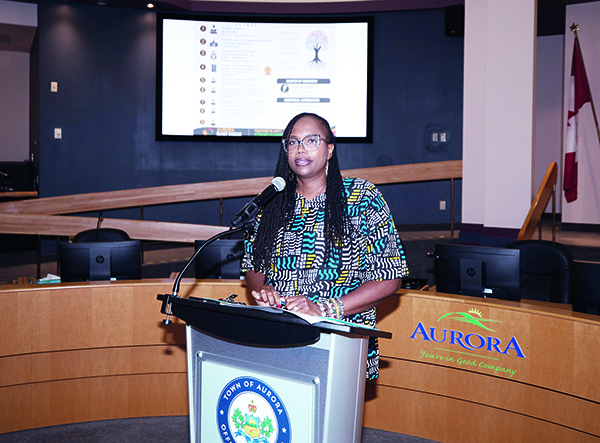
The community came together at Town Hall on Friday evening to mark Emancipation Day, commemorating the abolition of slavery throughout the British Empire in 1834.
Led by the Aurora Black Caucus’ Milton Hart and Ron Kellman, it was an evening that was both steeped in history and focused on the future as leaders shone a light on proactive ways to address historic wrongs, the impacts of which are still being felt today.
The evening, which was held in Council Chambers, included remarks from Newmarket-Aurora MPP Dawn Gallagher Murphy and Mayor Tom Mrakas, a video message from Ontario Premier Doug Ford, and messages delivered on behalf of Newmarket-Aurora MP Sandra Cobena, who was unable to attend due to the birth of her daughter earlier in the week, and on behalf of Aurora Black Community Association Founder and CEO Phiona Durrant.
Poignant reflections were also offered by Jerisha Grant-Hall, Founder and Executive Director of NACCA (Newmarket African Caribbean Canadian Association), Dr. Jeffery Thompson, Chair of the York Region Alliance of African-Canadian Communities, lawyer Maxine Palomino, and Aurora Black Caucus’ Michael Corniffe.
While the speakers reflected on the history of Emancipation Day, which Hart said the Caucus has extended to an Emancipation Month, they also focused on the future, and the efforts that all community members need to make to achieve true equity.
As important as it is to focus on the history of Emancipation Day, those who fought for freedom, and the impact it had on so many individuals around the world, Grant-Hall said it is important to not lose focus on what we can do today and the actions that can be taken in the here and now.
“Freedom was fought for, defended, demanded, and I want us to know this. The people who need to be in this room to hear this, unfortunately, are not here – the conversation disruptors,” said Grant Hall, adding freedom was carried in every single act of resistance and rebellion. “There is no need for us to debate the past. Today, what I want us to ask, what I want us to talk about is the future. The greatest question is, what does repair require? For too long, our response to slavery has centered remembrance, plots, proclamations, museums, and so on. These things matter. Memory matters. But memory alone does not heal trauma. Memory alone does not reduce health inequities. It does not improve Black maternal health. Memory alone does not create culturally-responsive mental health care, nor change educational outcomes. Memory alone does not build wealth, create leadership, or dismantle anti-Black racism.
“If we truly believe slavery was one of history’s greatest crimes against humanity, then our response cannot stop at commemoration. It must include repair. And this is why the conversation around reparations is important.”
When people say “reparations” all too often people think “handouts,” and that is far from the case, she continued.
“It means building structures, putting structures in place to repair the harm that we’ve inherited from slavery and colonialism,” she continued. “Ontario has already begun showing us what repair can look like, not by using the word ‘reparations’ per se, but by recognizing that anti-Black racism continues to shape health outcomes. Ontario Public Health Standards acknowledges that Black communities experience unique and persistent health inequities rooted in the legacy of slavery, colonialism, and systemic anti-Black racism. That matters. That recognition matters. It matters because once we acknowledge that history continues to shape health, we also accept responsibility for changing those outcomes. That is why Black mental health is not a niche issue. It is a health equity issue, a justice issue. It is reparative justice issue.
“People often imagine reparations as a cheque. I imagine something much bigger. I imagine Black-led mental health systems, Black-led research, Black-led organizations being adequately resourced, Black-led leadership being developed. I imagine scholarships, food sovereignty work, housing stability, community wealth, Black data sovereignty, spaces where our children see themselves reflected, where they don’t have to prove themselves worthy. Every one of those things repairs something that slavery and systemic racism attempted to destroy. That is reparations, my friends, not simply compensation. That’s recovery. That’s repair. That’s restoration.”
Grant Hall added she doesn’t want her own children to just learn stories about resilience, rather she wants them to “inherit systems that no longer require them to be resilient.”
“I want them to inherit communities where thriving is ordinary, where belonging is expected, where culturally responsive mental health care is available, where Black leadership is not exceptional, it’s expected,” she said. “I hope we leave here with the understanding that reparations are not about paying for the past; the reparations that we’re talking about is about building a future where the harms of the past no longer determine who gets a future, and if we truly believe that health is a human right, then repair is not optional. It is our shared responsibility and commitment towards full emancipation.”
These sentiments were echoed by Palomino, who delivered an address entitled “The Legacy and Responsibility of Emancipation.”
The lawyer said her views on Emancipation Day were filtered through her personal lens of a Jamaican and Canadian “with roots that reach before enslavement, like all of us, through enslavement, like some of us, and into resilience, achievement, and victory.”
“When I think about Emancipation, I think about our ancestors before enslavement. Their families, their governance structures, their laws, their traditions, their histories, their learning, their stories, their conflicts, their joys. I think about Timbuktu in present-day Mali, an important centre of scholarship centuries before emancipation, and I think about the leaders and the ordinary folk like us, walking, working, sleeping, loving, traveling, cooking, dancing, simply living,” she said. “Enslavement did not begin their lives. It interrupted their lives already being lived. I think about our ancestors who were ripped from their homes and those who remained. The belly-bottom pain, anguish, and terror of not knowing what happened…
“When I think about Emancipation, I think about Marcus Mosiah Garvey and his ideas around Black economic power, Black institutions, Black dignity – the organizations here that were spoken about echo those words. In 1920, the Universal Negro Improvement Association adopted the Declaration of the Rights of the Negro Peoples of the World. They spoke about racial discrimination, employment, education, equal treatment under the law, political representation, and economic opportunity. What year was that? 1920. More than 100 years later, what are we talking about? Anti-Black racism, employment equity, representation, Black entrepreneurship, education, fairness in our institutions. Sounds familiar…
“Emancipation Day, Black History Month, the days come, the days go, or the months come, the months go, and I look around this room and there are organizations and community leaders doing the work. Some we know, some I know do the work quietly. Yet people working toward connected goals can find themselves competing simply to survive or for limited resources. The needs are too great for that. That is why reparations are important, not simply because of what is owed for the past, but because of what is required to repair what continues into the present and into the future.
“I think of Emancipation, I wonder what it really says about the society, that the people experiencing injustice, name the problem, suggest the solutions, act on the solutions, but yet no matter what is accomplished, the hill still seems harder to climb. When we say ‘Happy Emancipation Day,’ yes, we celebrate our victories, we honor our history by knowing who our ancestors are, the steps they took, not simply what happened to them. We build on their work, we acknowledge that we are not starting from nothing. They did not arrive empty, that’s a myth. They laid foundations for us to build on and go beyond.
“Ask yourself, from what you have heard today, from the speakers before and just now, what will you do with it, how will you connect with your community, the organizations doing the work, how will you connect with them, how can we work together, how will you help move all of us forward, the Black community forward, and perhaps just as importantly, how will we know whether collectively we are actually moving forward instead of the cycle of restarting? Emancipation, for me, it is a continuous lesson. The learning is already there. Are we listening? Are we doing?”
By Brock Weir
Editor
Local Journalism Initiative Reporter


Readers Comments (0)
Headline News

Station rededication salutes a century-long legacy of fire service
A century-long legacy to local fire service was celebrated Thursday afternoon when the Towns of Aurora and Newmarket came together to rededicate the Edward Street ...

Commitment to Truth & Reconciliation underscored at Citizenship Ceremony
As September ends with National Day for Truth & Reconciliation, it began in York Region with a citizenship ceremony that underscored the importance of coming ...
Aurora Votes 2026: Mayoral candidates share views on Council compensation
Salary and compensation for Aurora’s Council representatives was a hot-button issue in the outgoing term of Council, with incumbent members taking different positions on recommendations ...

AMHA’s Early Bird Tournament attracts 81 eager hockey teams from across Ontario
Mayor Tom Mrakas and AMHA President Corby Saltzman presided over Opening Ceremonies of the 81-team, 13-division Aurora Early Bird Tournament at the ACC on Saturday ...


