
General News » News
Commitment to Truth & Reconciliation underscored at Citizenship Ceremony
October 1, 2026 · 0 Comments
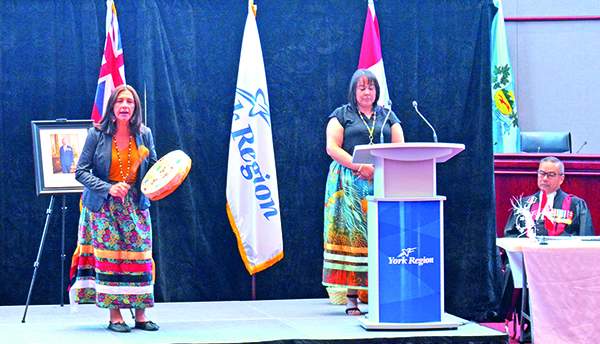
As September ends with National Day for Truth & Reconciliation, it began in York Region with a citizenship ceremony that underscored the importance of coming together for a better future.
The Regional Municipality of York helped welcome nearly 40 new Canadian Citizens at a ceremony held in Council Chambers September 14 to mark Global Welcoming Week.
Global Welcoming Week, also simply known as Welcome Week, was held September 10 – 19 to “celebrate newcomers and reaffirm York Region’s commitment to building welcoming and inclusive communities.” The Citizenship Ceremony was hosted in partnership with Immigration, Refugees, and Citizenship Canada, with the participation of Jodi Fox, an advocate for Indigenous inclusion, and Lauri Hoeg, an Anishinaabe artist from Georgina Island First Nation.
“On behalf of the Indigenous Relations team at York Region, it is an honour to be here with you on a day that represents such an important moment for you and your families,” Fox said, addressing the new Canadians. “Today, you will become Canadian citizens. You will leave here with new rights, new opportunities, and new responsibilities. But I would invite you to reflect on another question as well. What does it mean to belong to a place? From an Anishinaabe perspective, belonging is not simply about where we live or what documents we hold. It is about relationship: our relationship with one another, with the land and water, and with the generations who came before us, and those who will come after us. The lands we now call York Region have been home to Indigenous peoples since time immemorial, and continue to be places of gathering, relationship, responsibility, and ceremony. One teaching connected to these lands is the Dish with One Spoon wampum. This treaty was originally between the Anishinaabe and the Haudenosaunee, which dates back as far back as 1142 CE, pre-contact.
“The teaching reminds us that we all share one dish, the land, and that we each carry a responsibility for how we live within it. We take only what we need, we leave enough for others, and we keep the dish clean for those who will come after us. Most importantly, there is no knife at the table. To me, there is something especially meaningful about reflecting on that teaching at a citizenship ceremony, because today is not only about becoming part of Canada, it can also be an invitation to consider how you will be in relationship with this place. What will you learn about the land you now call home? Whose stories will you make space for? How will you care for what has been entrusted to all of us? And what will the generations who come after you inherit because of the choices we make today? Anishinaabe teachings remind us that our decisions extend beyond ourselves.
“We are encouraged to think about the generations ahead, to understand that what we do today can shape a future we may never personally see. That means reconciliation is not something belonging only to governments, institutions, or Indigenous peoples. It is a relationship that all people living here are invited to understand and to participate in. As new Canadian citizens, you bring your own languages, cultures, teachings, histories, and experiences with you. You do not have to leave those behind in order to belong here. They add life to the communities we share. My hope is that, alongside those traditions, you will also make space to learn about the First Peoples of these lands – not only our histories, but our living cultures, our rights, our languages, our teachings, and our continued presence today. Perhaps that is one way we can think about citizenship differently. Not simply as, what does this country offer me? But also, what responsibilities do I now carry to this land, to the people around me, and to those who will come after me? Today marks the beginning of a new chapter in each of your stories. May you care for the land and water that will also sustain your children, and your grandchildren. And may we all continue learning how to live together in a good way, sharing that one dish.”
Following a land acknowledgement, the presiding Citizenship Judge, Albert Wong, said it was very important to consider Reconciliation as “establishing and maintaining a mutually respectful relationship between Aboriginal and non-Aboriginal peoples in this country.”
“In order for that to happen, there has to be an awareness of the past, an acknowledgement of the harm that has been inflicted, atonement for the causes, and action to change behavior,” he said. “As you join the rest of the country on this important path of Reconciliation, make it a way of your life to show mutual respect with Indigenous peoples, their community, and culture. And work hard every day, really hard, in getting to know one another, truly know one another. In that way, we tangibly support this very important Reconciliation work that’s ongoing in our country right now….
“There’s 38 of you, and you come from around the world to become a Canadian citizen in this ceremony today. If we make it a way of our life, right now, starting right here, starting right now, to show each other mutual respect, and when we work hard, really hard, in getting to know one another, this is how we can deal with issues such as Islamophobia, anti-Black racism, anti-Semitism, anti-Asian racism in our society through mutual respect and through hard work in getting to know one another. This is how we can build a society that’s more just, more inclusive – not only for ourselves, but more importantly, for our children, and our grandchildren.”
By Brock Weir
Editor
Local Journalism Initiative Reporter


Readers Comments (0)
Headline News
Welcoming Arms celebrated for 20 years of community support
.

Audacity North aims to bring locally-grown solutions, innovations to the world
It took seven years for Keith Loo and his wife, Mila, to get a proper diagnosis for their son, Logan, who lives with a very ...

Raise Your Voice for APL for Ontario Public Libraries Week
The Aurora Public Library kick-started Ontario Public Libraries Week on Saturday with a cavalcade of entertainment in its Living Room space, including live music, circus ...
Paralympic Gold Medalist’s motto “Never Give Up” catalyzes Rosen’s enshrinement in the Aurora Sports Hall of Fame as athlete and broadcaster
Roger Lajoie, the legendary FAN590 broadcaster and author, interviewed Team Canada Paralympian gold medalist Paul Rosen for countless hours to structure the goaltender’s 2021 biography ...