
General News » News
CMHA, Oak Valley Health expand services for treatment-resistant depression
July 30, 2026 · 0 Comments
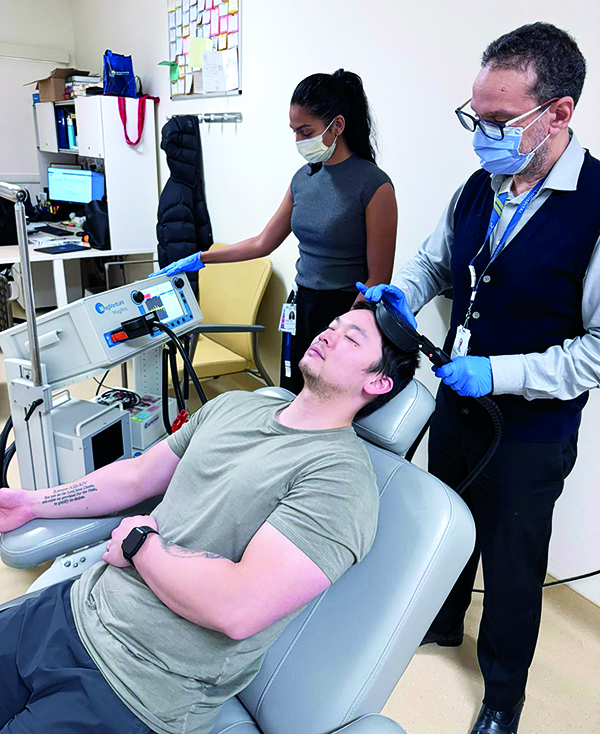
Depression can often be treated through psychotherapy and medication, but for those living with treatment-resistant depression, finding relief can be just out of reach.
New opportunities to get effective treatment close to home are now possible through a new partnership between the Canadian Mental Health Association of York Region and South Simcoe and Oak Valley Health, with a financial assist from the Provincial Government, to expand access to repetitive transcranial magnetic stimulation (rTMS).
rTMS is a non-surgical treatment and no anesthesia is required. The treatment involves a small magnetic coil placed on the head that delivers targeted magnetic pulses to areas of the brain involved in mood regulation. One course of treatment is typically 30 sessions at five days a week for six weeks.
The publicly funded rTMS program is available through Ontario’s Neurostimulation Procedures Provincial Program, supported by an Ontario Government investment of $5.4 million to expand access to treatment for adults with treatment-resistant depression across Ontario. Approximately $321,585 has been allocated to support service delivery at CMHA York Region South Simcoe in collaboration with Oak Valley Health. Ontario Health is leading implementation of the program through its Mental Health and Addictions Centre of Excellence.
“Partnering with Oak Valley Health to launch our first rTMS delivery site marks a transformative milestone for mental health care in our region and province,” said Andrew Chung, Chief Executive Officer of CMHA York Region South Simcoe. “By integrating this advanced treatment into the provincial program, we are directly breaking down barriers to specialized care. This collaboration embodies our commitment to building a high-quality and accessible mental health system that meets people exactly when and where they need it most, at no cost.”
Ashley Hogue, Senior Director of Provincial Initiatives for the CMHA-YRSS, says the contribution from Queen’s Park is part of the government’s plan to “build out a pathway for treating people who are struggling with depression and anxiety” in Ontario by creating a “stepped care path” with a variety of evidence-based services available “that are the gold standards in helping alleviate people’s symptoms related to anxiety and depression.”
“rTMS is… an important component of a more broad investment in helping people manage anxiety and depression,” she says. “This is really that next step in supporting people where medication and psychotherapy just isn’t working for them.”
When it comes to medication and psychotherapeutic treatments for depression, success can vary. While it works for many, sometimes it can have partial effect or no effect at all, says Yaakov Keilikhis, Director, Mental Health and Allied Health, at Oak Valley Health.
“There are now a few more options to treat that depression if people don’t respond well for medications and psychotherapy,” he says. “rTMS is a very evidence-based, approved treatment, which actually works very well with people who are not responding to other types of treatment. We have had the [rTMS clinic at Oak Valley] for a few years, but it was very limited to our own patients within the program. Now, with the expansion and public funding of the program, we can expand it for the entire region and we don’t need our psychiatrists to be very involved in the referrals. Referrals can come from family, physicians, nurse practitioners, [and] psychiatrists outside of OVH.
“This treatment is actually proven to [have a] 50 to 55% response rate for people with treatment-resistant depression and 30 to 35% remission rate, which makes it very close to something called electroconvulsive therapy, which is a golden standard for treating depression. However, rTMS actually is very non-invasive. It doesn’t require [being] under anesthesia. It doesn’t require a lot of time, doesn’t require hospitalizations or outpatient treatment. ECT requires people to stay in hospital for longer, requires anesthesia, they will not be able to work the same day. With rTMS, which has very similar effect as ECT, is probably a much more convenient and better treatment for people suffering from treatment resistant depression, which provides close, very close response rate and remission rates to ECT.”
Every individual coming to the clinic from external referrals are assessed by psychiatrists who decide whether rTMS is the right treatment for them.
“Although rTMS has been around for decades and has been an evidence-based treatment with really great outcomes, it hasn’t necessarily been accessible in this way before. Oak Valley has been providing rTMS for a number of years, but the pathway was within the hospital system,” says Hogue. “I think the exciting part of this program is that now primary care doctors or your family physician or nurse practitioner can submit a referral for a client to obtain access.”
Adds Keilikhis: “People who are going to ER department and seeking help from mental health professionals for depression, they just may come to our outpatient department and get the treatment scheduled for them during what’s convenient for them during that time, instead of going to ER and then being admitted to mental health inpatient units and being discharged and then only getting that treatment. That may actually save all that resource, all that time for patients to just move around the system, instead of going straight to the treatment which is the best for them. I think it’s really exciting. People who are struggling with depression for a while and have tried multiple treatments, in six weeks 50 per cent of them will have symptom reduction by receiving rTMS treatment, which I think is incredible.”
By Brock Weir
Editor
Local Journalism Initiative Reporter


Readers Comments (0)
Headline News
Welcoming Arms celebrated for 20 years of community support
.

Audacity North aims to bring locally-grown solutions, innovations to the world
It took seven years for Keith Loo and his wife, Mila, to get a proper diagnosis for their son, Logan, who lives with a very ...

Raise Your Voice for APL for Ontario Public Libraries Week
The Aurora Public Library kick-started Ontario Public Libraries Week on Saturday with a cavalcade of entertainment in its Living Room space, including live music, circus ...
Paralympic Gold Medalist’s motto “Never Give Up” catalyzes Rosen’s enshrinement in the Aurora Sports Hall of Fame as athlete and broadcaster
Roger Lajoie, the legendary FAN590 broadcaster and author, interviewed Team Canada Paralympian gold medalist Paul Rosen for countless hours to structure the goaltender’s 2021 biography ...