
General News » News
Citizen of the Year raises alarm bells over the state of community volunteerism
October 29, 2026 · 0 Comments
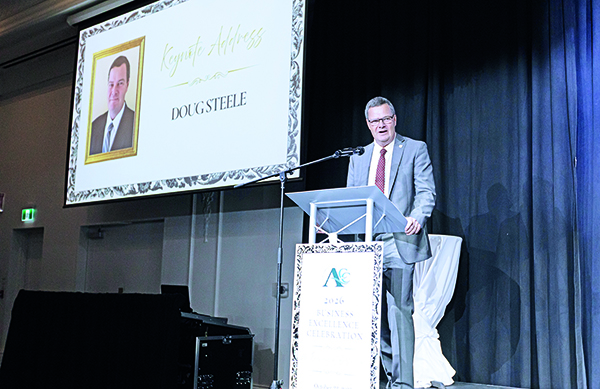
Aurora’s Doug Steele is an active and long-standing community volunteer.
At the age of 61, Aurora’s 2026 Citizen of the Year stays active in many areas, including serving as Chair of the Executive Council at Aurora’s Welcoming Arms, and staying hands-on as a dish washer after their weekly community meal programs.
But, as he looks over the teams of dozens of volunteers who come together to make the organization tick, he finds himself “on the young side” of those tireless people who give so much to local non-profits.
“That scares me,” said Steele, who served as keynote speaker at last week’s Business Excellence Awards hosted by the Aurora Chamber of Commerce. “As many people who have supported community organizations for decades, we are getting older, we can’t assume there will automatically be another generation of volunteers ready to take their places.
“I don’t necessarily believe this means younger people don’t care about their communities. Of course, people have a lot of competing demands for their time: they’re working, raising families, caring for aging parents, and dealing with the daily complexities of life. Some would probably be quite willing to volunteer, but simply can’t commit on a regular schedule. Others may not know what opportunities are available or how to get involved.”
Steele has been a part of the local business community for decades, working in the hardware and wholesale industries, as well as operating two small manufacturing firms. The long-time contributor to the councils of the schools where his children were educated, as well as to the Aurora Cares Community Action Team, Steele took the opportunity of his keynote as a chance to rally the group of business and community leaders at the Royal Venetian Mansion on October 22 to re-think what it means to be a volunteer and opportunities the community as a whole can provide.
“In 2024, the Mayor asked me to join the newly re-established Aurora Community Cares Action Team, which has been comprised of several individual citizens, members of the Lions Club, Rotary Club, Salvation Army, Welcoming Arms, and York Regional Police. The purpose of this group was originally to help people during the pandemic. Now it serves to address situations that fall outside the local service group’s mandates,” Steele shared.
“In the two years that I’ve been involved, we have done things including providing backpacks and school supplies for Aurora students whose families are in need and funded school-based meal programs, as well as coordinating activities between our local agencies. The collaboration between our groups has been very productive. It’s a good example of what can happen when organizations work together. No single group has the resources or all the answers, but by sharing what we have and making use of one another’s strengths, we can often accomplish a great deal more.”
During that time, however, he said he has also seen the wealth gap widen across the country, more and more people needing help to get by – “some on a daily basis” – while homelessness has grown.
“In the big picture, raising up those in need helps make our community stronger, socially and economically. It helps build a more cooperative community that will benefit everyone, residents and businesses alike,” he said. “We’re celebrating four local not-for-profits tonight, all who do great work in making things better for our community. Keep in mind there are literally dozens of other not-for-profits that serve the Aurora area as well. Almost all of these groups survive on volunteers. For example, Welcoming Arms has two-and-a-half part-time staff and 175 active volunteers. Volunteers are essential to our continued operation. Here’s the problem: across Canada, volunteering participation has been declining.
“According to Statistics Canada, formal volunteering rates dropped from 41% in 2018 to 32% in 2023. That’s a decline of nine percentage points in just five years, and the rates were dropping prior to that study. Not only have the numbers of volunteers dropped, but also the number of hours spent by those still volunteering has also dropped. Across Canada, the average annual contribution from volunteers fell from 206 hours in 2018 to 173 hours in 2023. These figures represent a significant loss of volunteer time. For organizations that depend on people giving their time to keep their programs running, that loss can be difficult to make up, especially when the need for their services continues to grow.
“Ontario’s requirement for high school students to complete 40 hours of community service is a worthwhile introduction to volunteering. It gives young people an opportunity to see firsthand what some of these organizations do, but completing those hours don’t necessarily mean that someone will continue volunteering as an adult. I think we need to look at how we encourage that involvement to continue after the school requirement has been met.
“These findings confirm what many in the non-profit sector have been feeling for some time. We’re coming to a critical juncture. With fewer donors, fewer volunteers, and increasing community needs, organizations are being pushed to do more with less. Without active recruitment, volunteers are not being replaced at a sufficient pace to keep them viable. But recruitment is only part of the problem. We also need to retain the volunteers we already have. People need to feel their time is being put to good use, that their contribution is being appreciated, and that they can continue to be involved even when their circumstances change.
“If we don’t address these issues, there could be some serious consequences. Organizations may eventually have to reduce programs, limit the number of people they can serve, or discontinue some services altogether. When that happens, the need doesn’t disappear. It simply places more pressure on families, other agencies, and the community as a whole. I don’t think we can afford to wait until organizations are struggling to keep their doors open before we start looking for solutions.”
By Brock Weir
Editor
Local Journalism Initiative Reporter


Readers Comments (0)
Headline News

Aurora returns Mrakas for third term as Mayor, elects four Council newcomers
Mayor-elect lauds community for “kicking negativity to the curb”

Chamber recognizes entrepreneurship, growth and community at Business Excellence Awards
Sandra Farran was 60-years-old when she decided to start a new chapter in her own life. In the two years since she opened Saltbox Café ...
New and returning faces on Council looking forward to getting to work
Aurora residents elected a dynamic new Council on Monday night, with four first-time Councillors joining two long-time incumbents – with the majority of representatives at ...

Former NHLer and founder of ‘50 Mission Cast’ Shayne Stevenson skates and fishes his way into the Aurora Sports Hall of Fame
Aurora’s Shayne Stevenson has found a recipe for enjoying life after an eleven-year professional hockey career, including three seasons with the Boston Bruins and Tampa ...