
General News » News
Artist paints old family photographs into vivid portraits designed to spark memory
September 3, 2026 · 0 Comments
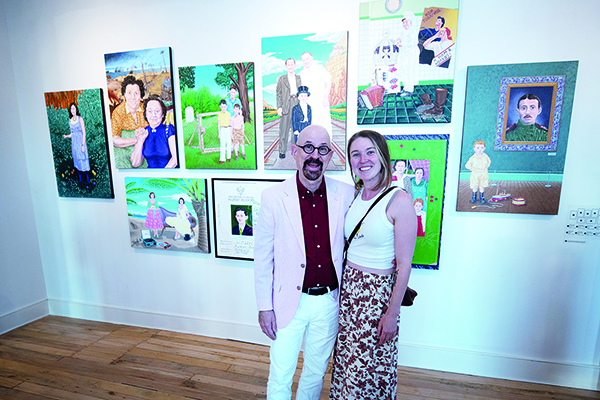
When animator Arnie Lipsey was looking for a new way to express himself, he looked back to his first love, paint, as a new creative path.
He found inspiration in a stack of old family photographs, but the black-and-white images lacked that certain pop. He challenged himself to reinterpret the monochrome photographs through paint on canvas, transforming them into vivid technicolour.
“I found that translating old photographs into colour was a challenging technical exercise,” he says, “but I wasn’t getting a way of really describing the people that I was portraying – not just as a straight, physical thing, but trying to inject more meaning to make the images a little more potent.
“I didn’t set out with any great agenda to continue to do that, but as I went from painting one photograph to the next, which I just simply found myself doing because the first couple were so impactful, I just found a groove and kept following it until 40 canvasses later, it’s developed into a body of work.”
It’s a body of work which challenges the viewer to consider when memory mixes with imagination in “Arnie Lipsey: Past. Tense.,” a new exhibition which opened Thursday at the Aurora Cultural Centre.
Running through October 31, the show “uses painting to trace a family history shaped by immigration, trauma, and silence,” says the Centre.
“The artist leans into the surreal to bridge the gap between what is remembered and what can only be imagined. “As a second-generation Jewish Canadian, Lipsey paints from a position of postmemory – a term that describes the ways in which the trauma of previous generations is internalized through stories, images, and cultural memory.
“His parents, European Jews who immigrated to Montreal before World War II, escaped Nazi persecution but lost many relatives in the Holocaust. Drawing on his family archive, Lipsey reinterprets black-and-white photographs into fantastical compositions that bring into focus the cultural, historical, and personal circumstances that linger beyond the frame. Through complex symbolic language and unexpected juxtaposition, Lipsey’s work reveals the interpretive layers through which family narratives are continually reimagined.”
One such image, a favourite of the artist that does just that is entitled Gallery View.
It depicts a little boy which Lipsey describes as “looking a little bit intimidated, with a portrait on the wall behind him.”
“The little boy is my uncle,” he says, explaining he grew up with his mother and siblings after his father “had to leave in a hurry.”
It was between the wars, he says, and the elder man was involved in subversive political activity.
“The picture that is portrayed is of this young boy whose father, as far as he was concerned, abandoned him – that was when he was conscripted into the army. They were both very really striking images, both taken in professional photography studios, but I could see their relationship and they had to tell that story.”
Every painting starts with a photograph, and every photograph depicted is one to which Lipsey feels a strong, instinctive connection, while sparking an emotional pull.
This pull was also felt by Ashlyn Gregory, Gallery Manager at the Aurora Cultural Centre, who said curating the exhibition, learning about each painting, and the process that went into making each painting a reality has been a “rewarding experience.”
“I want people to come into this exhibition and learn more about Arnie’s story, but also look at the images and apply them to their own lives because I think, to some degree, we all have an ingrained narrative that we project onto the past,” she says. “I want people to think about those layers of interpretation and the gaps between what we’ve been told, what we know, and what we’ve had to interpret and fill in ourselves.
“In the curation process, we intentionally tried to strike a balance between telling and showing. There’s some extended labels throughout to explore Arnie’s stories a little bit deeper to give people more context, but we purposely didn’t do that for all the works because we want people to draw their own conclusions and project themselves onto those canvases and think about how they reflect on their own family stories.”
Lipsey nods in agreement.
“No one sat me down as a kid and drew out a schematic of how everybody was related to who and giving me names and dates. You don’t grow up like that, you have bits and pieces of throwaway lines and references and you have to gain a certain maturity before you even know what questions to ask,” he says. “As a child, you’re not equipped. You come away with bits and pieces of things that were probably historically-accurate, maybe not. You stitch things together and you come up with a timeline that seems to make sense and you’re left with your own version of family history.
“That resonance will, I hope, trigger some questioning of their own stories, because now we’re working on a kind of a more intimate and real level, and they can connect their own experience to what they’re seeing in front of them. Maybe their family history is also one of immigration, voluntary or not. I think this is an attempt in, to some extent, in provoking people to think about that stuff. I think every artist wants to transmit emotion. He wants people to look at their work and feel something. I think if you make sure that it’s personal and truthful, people will respond in kind.”
By Brock Weir
Editor
Local Journalism Initiative Reporter


Readers Comments (0)
Headline News

Break the Silence walk to mark 10th anniversary with expanded outreach
.
Victoria Hall restaurant will carry on legacy of Aqua Grill
Aurora’s Victoria Hall will soon begin a new chapter as a restaurant, peppered with the flavours many local foodies have come to know and love ...

One-hundred-year history of St. Andrew’s College in Aurora celebrated in heritage showcase
St. Andrew’s College has been dedicated to boys’ education for more than 125 years. Now, as the school marks 100 years since it moved from ...
Biondic’s inspirational life as a marathoner, ultramarathoner, and community builder stamps his ticket into the Aurora Sports Hall of Fame
After 25 years as an ultramarathoner and 20 years of experience as a marathoner, George Biondic knows a thing or two about ultrarunning. The dynamic ...