
General News » News
Aurora Votes 2026: Town needs to “Get Moving” on grade separation on Wellington, says Gallo
September 18, 2026 · 0 Comments
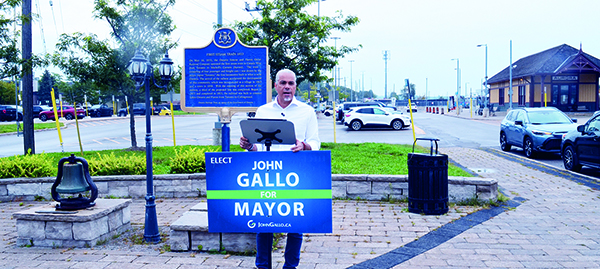
Aurora needs to do all it can to advocate for grade separation on Wellington Street East as Metrolinx and GO Transit prepare for a significant increase in train traffic on the Barrie Corridor.
That was the message delivered by mayoral candidate John Gallo outside the Aurora GO Station on Wednesday morning as he launched his “Get Aurora Moving” plan.
The plan emphasizes several ways to improve local traffic flow, from long-proposed vehicle underpass where Wellington meets the train tracks, advancing a traffic interchange at St. John’s Sideroad and Highway 404, and improvements to Industrial Parkway.
“There’s one issue that I hear most about everywhere I go in Aurora is traffic, at the doors, in our neighbourhoods, from businesses, from parents trying to get their kids to their activities,” said Gallo. “People are frustrated and I understand why – because getting across Aurora shouldn’t be this difficult.”
His “Get Aurora Moving” plan is intended to “tackle the transportation challenges we face today and start planning seriously for the infrastructure we need tomorrow,” he said.
“Let’s start with one of the biggest challenges facing our community: the rail corridor that runs right through the middle of Aurora. GO service is expanding. That’s a good news story for commuters and good news for Aurora,” he said, but added that more trains also means “more frequent interruptions on the roads connecting the east and west sides of our Town. Metrolinx and the Town [are] undertaking a traffic analysis around the Wellington Street crossing. That information will be important in understanding the impact on traffic, nearby intersections and surrounding neighborhoods.
“But let me be clear about my position: regardless of what the study ultimately tells us, Aurora needs a grade separation at Wellington Street, and we need to start treating it with the urgency it deserves. Wellington is one of our most important east-west corridors, and train frequency increases, leaving one of Aurora’s busiest roads dependent on a level crossing. It is simply not a sustainable long-term solution. As Mayor, I will make securing that great separation a priority. I will work with Metrolinx, York Region, our MPPs and province to build a case, secure the funding and establish a real timeline to get it done.”
If elected Mayor in the October 26 municipal election, he said he will also work to build the case for an interchange at St. John’s Sideroad and Highway 404, something for which Council has long identified as a local priority.
“We know the need is there. Now we need to turn years of discussion into action with a funding project and a realistic timeline,” said Gallo. “But Get Aurora Moving isn’t just about major infrastructure. It’s also about the roads we use every day. Industrial Parkway is a perfect example of why Aurora needs a different approach. In 2015, then-councillor Tom Mrakas brought forward a motion dealing with widening Industrial Parkway. Then, in the 2018 election, he campaigned on moving that project forward. Eight years later, where are the results? Industrial Parkway remains an important north-south alternative to Yonge Street, yet we are still talking about many of the same traffic problems. That is exactly what I want to change.
“We need to take a serious look at Industrial Parkway, better signal coordination, recurring bottlenecks and how our entire road network works together. We need solutions for Yonge Street that improve traffic movements while supporting a vibrant, walkable downtown we all want to succeed.”
Referencing incumbent mayoral candidate Mrakas’ campaign slogan “Getting Things Done,” Gallo said results on traffic haven’t been realized.
“It means moving projects forward. It means securing commitments. It means being accountable for what was promised and what was actually delivered. After eight years, Aurora residents have the right to ask, what got done on transportation projects we were promised? Aurora has spent enough time talking about transportation projects. We need to start delivering them.”
By Brock Weir
Editor
Local Journalism Initiative Reporter


Readers Comments (0)
Headline News

Break the Silence walk to mark 10th anniversary with expanded outreach
.
Victoria Hall restaurant will carry on legacy of Aqua Grill
Aurora’s Victoria Hall will soon begin a new chapter as a restaurant, peppered with the flavours many local foodies have come to know and love ...

One-hundred-year history of St. Andrew’s College in Aurora celebrated in heritage showcase
St. Andrew’s College has been dedicated to boys’ education for more than 125 years. Now, as the school marks 100 years since it moved from ...
Biondic’s inspirational life as a marathoner, ultramarathoner, and community builder stamps his ticket into the Aurora Sports Hall of Fame
After 25 years as an ultramarathoner and 20 years of experience as a marathoner, George Biondic knows a thing or two about ultrarunning. The dynamic ...