
General News » News
Aurora family pays it forward with $2 million donation
February 9, 2017 · 0 Comments
By Brock Weir
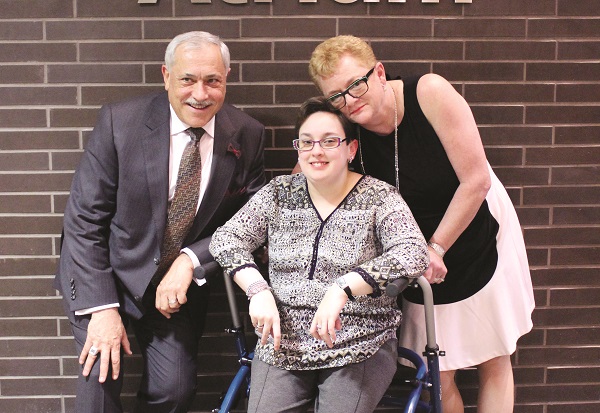
Aurora’s Jessica Coriat thanks the doctors and staff of Toronto’s Hollandview Bloorview Kids Rehabilitation Centre with helping her to learn how to live independently.
Born with cerebral palsy, Ms. Coriat has gone from being a patient at the hospital to an enthusiastic volunteer, helping youngsters find that same independence.
The Coriat family, however, has taken paying it forward to a new level, donating a whopping $2 million to Holland Bloorview to help others make this transition.
Holland Bloorview announced the Aurora family’s donation last week, which is part of a $4.78 million donation to facilitate a multiyear strategy designed to transform how kids with disabilities reach adulthood. According to the hospital, the Transitions Strategy will “transform the journey to adulthood for kids with disabilities by breaking through barriers, partnering with leading adult services, and developing a young adults program to address the needs of 16 – 26-year-olds.
“I realised we’re fortunate enough to be able to do it,” says Jessica’s father, David. “My daughter was born with cerebral palsy and I see what Holland Bloorview could do in terms of helping kids with disabilities. The program we discussed, Transitions to Adulthood, effectively showed these young people how to take care of themselves both from a healthcare standpoint, and financially because when you reach 18, government help stops. Somehow they have to deal with what life throws at them.”
Joining the David and Lynn Coriat in making this program possible is the Slaight Family; Gluskin Sheff + Associates Inc; Jon and Nancy Love; La Fondation Emmanuelle Gattuso; BloombergSen; RP Investment Advisors LP; Gerald Sheff and Shanitha Kachan Charitable Foundation and RBC Foundation.
“With any program, you need funding and we decided to step up and provide a good chunk of the funding, and with some very supportive business associates, who helped us raise the money. In all, we know the program is going to be funded for at least five years.”
The donations were, of course, welcomed by Holland Bloorview who said these transition needs had long been identified by their client families, whether this feedback came from youth and their parents questioning what their next steps are when they are no longer in the pediatric system; what happens when they move from being a youth to adult in terms of independent living, employment, and post-secondary education; and even general life skills.
“We have created a utopia at Holland Bloorview for kids with disabilities where we have thought about all of their holistic needs…but once they become adults, that doesn’t exist in the same way,” says Sandra Hawken of Bloorview. “We knew we had an important role to play in the system, and with our families, to set them up for success as adults.”
Some of the key pieces, she says, are addressing barriers and gaps already existing when it comes to employment, independent living, and education. Programs already exist at the hospital to address that, but there was a definite need to expand them so more kids inside and outside Holland Bloorview have the opportunity to participate in programs that expand these horizons.
“One of the biggest pieces this transition strategy will enable at Holland Bloorview is a wholesale shift in the way we do things,” she says. “We’re committed to ensuring that every single client has a transition plan in place. Right now, that would be true for a smaller group of clients we have identified have that need but now we want to make sure that, regardless of the age of the child, as soon as they come into Holland Bloorview, we’re talking to them about all of the transitions their child will have through their childhood and beyond so it doesn’t become a scary time when your child becomes 16 – 18 and you have to think about what comes next.”
Through the program, Holland Bloorview hopes to be able to “build bridges” between the services they offer and opportunities elsewhere in the healthcare and education systems. Right now, those systems are very complex, Sandra says, and clients are often left navigating them on their own, or with their families who are often continuing on in their caregiver role.
These are issues that have been identified by Mr. Coriat as well. These youth need to know how to access healthcare, go to the doctor, advocate for their ODSP, and teach them how to manage their dollars. As Jessica and her parents worked to navigate the system, David says he saw clients with strong family support systems in place, some single parent families, and some families struggling to afford the equipment their child needed to get by.
“Many had no idea how to reach out and get that equipment,” says David. “Our vision is the program will roll out [in a few years] across the various areas of Ontario and the grand vision is that it [fosters] Canada-wide programs where they work with all the various hospitals and agencies across the country. We view it initially as Toronto and York centric, but we would like to see it Ontario-centric and Canada wide. Canada-wide would take 10 to 20 years before it gets there, but I think in five to ten years there is a good chance it can be Ontario-wide.”


Readers Comments (0)
Headline News
Winterfresh event raises $60,000 for York Region Food Network, Community
.
Aurora Town Square comes to life this month with bursts of colour, nostalgia
Town of Aurora's second-annual Holi festival is set for this Sunday, March 15, at Aurora Town Square.
Region raises alarm bells over opioid use, declining mental health
York Region Public Health is raising alarm bells after recent studies have identified worrying trends when it comes to mental health, opioid use among youth, ...
James Thomson named Head Coach and General Manager by the Aurora Junior A Tigers for 2026-27
James Thomson lost his interim Head Coach label on Monday afternoon as the Aurora Tigers announced that their current General Manager will add Head Coach ...


