
General News » News
Aurora Votes 2026: Meet Your Council Candidates – Lauren Hanna, Ward 1
October 19, 2026 · 0 Comments
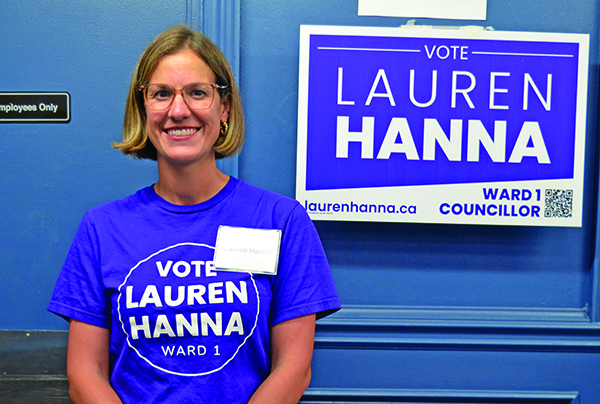
As one of the first two residents to put themselves forward as a Council candidate ahead of the October 26 municipal election, Lauren Hanna has had a lot of time to knock on doors in Ward 1. Council collaboration was a key priority from the outset, and the more she hears from voters, the clearer it becomes that cohesion is what residents are looking for, she says.
“When I set out, my overarching priority was always just to bring a fresh collaborative perspective to Council. That remains the case, and it seems to resonate with people that they’re keen to have someone who is very engaged in the community, energetic, passionate, and hopes to maybe bridge some divides that have existed on Council in recent years.”
The desire to foster Council cohesion has worked hand-in-hand with three priorities Hanna set from the start: engaging residents, ensuring people felt that government was accountable, and ensuring residents have a sense of belonging.
These are still as important as ever, she says, but the campaign has allowed Hanna to bolster her platform when it comes to engagement and communication. Better communication by Council on the decisions it makes, she says, improves accountability, while the facets of belonging and inclusion are wide-reaching, encompassing everything from road safety to playground accessibility.
“My approach has been very focused on listening and I just think that is so important,” she says. “A lot of the conversations have been framed around me saying, ‘What’s important to you? What’s top-of-mind going into elections? Do you have local priorities or concerns?’ Usually, they seem to be related in some way to engagement, accountability, or the right infrastructure to ensure belonging. For engagement and communication, I just think we can do a better job within our Ward and Town-wide…. I really think that conveying to residents that I’ll be someone who is looking to get them involved in decision-making, to hear from them, to make sure they know what’s happening at Council and why decisions are made. I think that’s kind of a compelling piece of my platform. I’m hoping that it resonates. Most people at the door, they nod and agree because I think most people have some experience in recent years where a decision was made or a consultation happened and they didn’t realize. They only learned about it after the fact, and they wish that they had realized and not only been involved, but had an understanding of how to be involved.”
Some municipal decisions and decisions made beyond Aurora that still impact the community Hanna says would have benefited from improved communication and engagement include developments around the McKenzie Marsh on St. John’s Sideroad near Yonge Street, and around the future of Victoria Hall, which she said should have been subject of a consultation process and “community engagement upfront” before a decision was made.
“It’s probably a missed opportunity to involve residents and then hopefully enter a buy-in in the project,” she says.
Her commitment to accountability, she says, is underscored by her work in the office of Ontario’s Auditor General. Many people have “lost trust in government” in recent years – “locally, nationally, worldwide” – and that social media has fuelled a degree of tension. Anything leaders can do to “cultivate trust” in Council, government, and the public service, is important, she says.
“I’ve committed that I’d push for more strategic planning and annual reporting on goals and progress towards them. That’s something we did a lot at the Auditor General’s office. Sometimes really good things are happening, but unless you’re also sharing that information transparently the public doesn’t know,” she says. “At the end of the day, it’s their money, so I think it’s important to do what we can to amplify that.”
Another issue that has cropped up frequently at the door, she says, is “managing growth in a thoughtful way.” As a resident of the community “for the better part of 40 years,” she says she has seen the impact of development, and pressures related to traffic, green spaces, and infrastructure.
“Obviously we’ve got growth targets and I don’t think growth is inherently bad, but we need to do it in a thoughtful, balanced way,” she says. “That’s top-of-mind for me, making sure that we still preserve the character, the green spaces, and the liveability of Aurora that I think people love – that’s why people have chosen to live here or stay here – and making sure that we are really thoughtful and deliberate about how we maintain that. I think it’s very important.
“I think it’s just really important that we have some fresh voices on Council that are really committed to collaboration. I think that’s what will serve the best interests of residents. The reality is that most issues are not black or white, and you’re not always going to agree with something … I don’t think residents’ best interests are served if you’re always sort of siding with one faction or the other. I prefer to see that, moving forward, our Council works more respectfully and collaboratively. I think that will be in the best interest of Ward 1 residents. That’s something I really tried to emphasize along the way.
“I think it’s great to have someone, whether it’s me or others who are running, too, to have people that have got young families. That’s something that’s been kind of missing on Council in recent years in terms of having a voice on there that does have young children who are actively navigating the school systems and the daycares and at the playgrounds and doing all the activities. I think that would be great to have on there as well.”
By Brock Weir
Editor
Local Journalism Initiative Reporter


Readers Comments (0)
Headline News

Break the Silence walk to mark 10th anniversary with expanded outreach
.
Victoria Hall restaurant will carry on legacy of Aqua Grill
Aurora’s Victoria Hall will soon begin a new chapter as a restaurant, peppered with the flavours many local foodies have come to know and love ...

One-hundred-year history of St. Andrew’s College in Aurora celebrated in heritage showcase
St. Andrew’s College has been dedicated to boys’ education for more than 125 years. Now, as the school marks 100 years since it moved from ...
Biondic’s inspirational life as a marathoner, ultramarathoner, and community builder stamps his ticket into the Aurora Sports Hall of Fame
After 25 years as an ultramarathoner and 20 years of experience as a marathoner, George Biondic knows a thing or two about ultrarunning. The dynamic ...