
General News » Headline News » News
One-hundred-year history of St. Andrew’s College in Aurora celebrated in heritage showcase
October 16, 2026 · 0 Comments
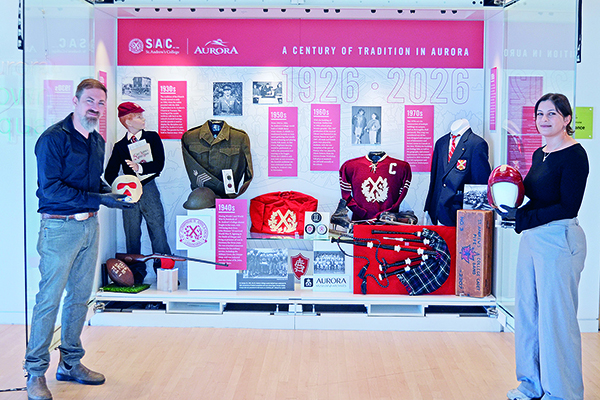
St. Andrew’s College has been dedicated to boys’ education for more than 125 years. Now, as the school marks 100 years since it moved from its first campus in Toronto’s Rosedale neighbourhood to its long-time home on Yonge Street, just south of St. John’s Sideroad, a century of local history is now in focus at Aurora Town Square.
This journey is now in the spotlight thanks to a collaboration between the Aurora Museum and Archives and archivists at St. Andrew’s College, who have curated an expansive variety of artefacts, photos, and more to tell the story in St. Andrew’s College: A Century of Tradition in Aurora.
For the archivists at both organizations, it is a chance to not only celebrate a milestone anniversary of an important community institution, but also shed a light on what goes on “behind the gates.”
“I grew up in Whitchurch-Stouffville my whole life and I wanted to show bits of St. Andrew’s to people outside the school who don’t see it very often,” says Gabby Jackowski, Archivist at St. Andrew’s College. “People see cadets all the time on parade in different places in Aurora and I wanted to show other aspects of the school that people would not always see.”
This was an area Jeremy Hood, Museum Collections Technician for the Aurora Museum and Archives, also wanted to explore.
“There really is a huge cross-section of boys, different ages, different interests and abilities – it’s not just a football school, it’s not just a hockey school, there’s the art side, the drama side, the STEM side, and I think that is something that people don’t really recognize,” he says. “It really is a whole learning environment, and I think that really comes out in seeing the cross-section of items that were selected.
“I have to say the curation was overwhelmingly definitely Gabby’s curation. It was important for us not to try and take over and do too much of an Aurora Museum Archives treatment and make sure that it’s also really a St. Andrew’s exhibit.”
Amongst the more than 100 artefacts now on display in showcases throughout Aurora Town Square and into the Aurora Public Library, both Jackowski and Hood have a few favourite pieces they feel really help underscore the story.
For Hood, a particularly evocative piece of archival material is a 1946 aerial photo taken by the National Air Photo Library capturing in high resolution what the expansive campus looked like at the time. For Jackowski, it comes back to items like cadet swords, surviving student uniforms that show how they have evolved over the last century, a “plushie” of a SAC football player dating back at least to the 1920s, and a student’s photo album from the 1940s that not only captures the school and student life in a single moment in time but – in music to the ears of archivists everywhere – identifies each and every student photographed by name.
Members of the public have until mid-December to take in the story and, as they do, Hood says he believes the exhibition as it has come together really unifies past, present, and future.
“There was a 27-year history in Rosedale, but it speaks to the eternal link between Toronto and Aurora. There has always been [this idea] that Aurora’s just the right distance from Toronto…and it is such a fascinating way they interact. It gives Aurora an outsized impact on Ontario, I feel, and I think St. Andrew’s is an excellent example of that,” he says. “The past, present, and future, bringing us 1926 and how it integrated with Aurora at the time as it was growing and how it maintained that growth through the war period, being significant in the war period, and then the cadets being so significant in the post-war period, and then in the present and in the future, we have St. Anne’s as well. This expansion is… so woven into the fabric of Aurora, but also Ontario, and it’s just only growing right now.
“Some of the traditions are old, but seeing all these young boys in bright red serge walking down Victoria Street is just like a fascinating thing to me. There’s this glorious maintenance of tradition, but still pushing forward, and not a lot of things are able to ride that line so well.”
By Brock Weir
Editor
Local Journalism Initiative Reporter


Readers Comments (0)
Headline News

Break the Silence walk to mark 10th anniversary with expanded outreach
.
Victoria Hall restaurant will carry on legacy of Aqua Grill
Aurora’s Victoria Hall will soon begin a new chapter as a restaurant, peppered with the flavours many local foodies have come to know and love ...

One-hundred-year history of St. Andrew’s College in Aurora celebrated in heritage showcase
St. Andrew’s College has been dedicated to boys’ education for more than 125 years. Now, as the school marks 100 years since it moved from ...

Biondic’s inspirational life as a marathoner, ultramarathoner, and community builder stamps his ticket into the Aurora Sports Hall of Fame
After 25 years as an ultramarathoner and 20 years of experience as a marathoner, George Biondic knows a thing or two about ultrarunning. The dynamic ...