
General News » News
New book from Head of School challenges traditional concepts of classroom education
February 26, 2026 · 0 Comments
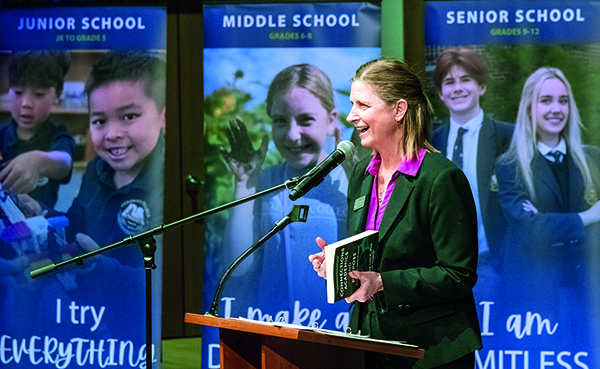
The role of a teacher used to be to impart information.
This role has significantly shifted in recent years, says Dr. Cinde Lock, and schools need to recognize this to stay relevant in a window as short as five years.
“Look at the world we live in,” she says. “With AI, everybody is going to have their own private tutor soon – they already kind of do – and it can push them along, help them learn, and give them oodles of extra questions, things to think about and context. If we want to be relevant in five years’ time, we’d better rethink what school is, what we can amplify, and what we can help bring alive that AI can never do – and that is human connection.”
Dr. Lock, an educator of more than 30 years and now Head of School at Newmarket’s Pickering College, explores this topic in-depth in her new book Connections, Academics, and Purpose: Designing the Future of School.
Co-authored with her daughter, Anneke Lee, the book explores “a bold and timely reimagining of education – one where learning begins not with curriculum expectations, but with authentic connections, real-world problems, and meaningful community partnerships.”
First published in January and formally launched at Pickering College last week, nearly 900 books had been sold at press time this week and it has already sparked a conversation.
Human connections, says Dr. Lock, can include fostering an environment where students feel involved, valued and heard, and where they can better understand and connect with the world around them.
It is essential to help students forge a meaningful link between some of the challenges facing our world and be a part of the change they want to see in the world. Connecting them with changemakers can help students see the issues through a new lens and see that they can make a valuable contribution.
“From a very young age, they can say, ‘I want to be a part of that journey. It’s informed citizenship and engaged citizenship. It’s also building empathy. It helps them feel like their learning is purposeful and meaningful,” Dr. Lock explains. “It’s not for the purpose of just being graded. If you go into a traditional school, every day you’re just being assessed. It’s about assessment and not learning.”
“We’re doing that in spades at Pickering College and this is really a love story to Pickering in so many ways, but it’s so much broader than that because it’s about a vision for what school should be and it’s a methodology for teachers on how to actually put it in place.”
Other types of schools and other educational institutions are so ingrained with existing systems and potentially outdated ideas of what universities are looking for in accepting first-year students out of the high school environment, Dr. Lock says.
She cites a recent discussion with a teacher just out of school as a prime example of this way of thinking. When Dr. Lock asked how the teacher could make her math lesson more interesting, the teacher linked the equation of a curve with art. But that didn’t necessarily underscore the purpose of why students need to make that calculation in the first place.
“What if the student went away and said, ‘there’s something really cool in that, and I thought it was really interesting,’ and, on their own time and in their own way, went and extended the project far beyond what you’d ever originally assigned?” she says, relating a question she posed to the educator. “What if the student comes back four weeks later and says, ‘Look what I did! I’m so excited about this.’ Would you change the grade in the original assignment?’ The teacher said no, and I asked why? What is it that’s so ingrained in your thinking about student learning that your timing and structure have to be so tight that you don’t want to encourage, nor do you want to accept a student that’s gone far beyond, and you don’t want to credit it because somehow that’s an advantage that student had that no other student did?”
The newly minted teacher stuck to their guns and said going down that route would result in “everybody getting 100 per cent,” says Dr. Lock.
“Why is that bad? Isn’t that learning? Don’t you want students to be passionate about their learning? Unfortunately, this is a narrow view of school – it’s about the assessment more than the learning, more than it is about the passion or the interest in learning. If we want to have anything other than disengaged kids, we’ve got to make changes.”
As Connections, Academics, and Purpose: Designing the Future of School continues to reach educators and parents alike, Dr. Lock says she wants the volume to “create a movement.” She senses an opportunity to foster change, she says, just as Pickering College instills in its own students.
“I want to take advantage of the opportunity I have because the truth is the public school system is a bigger, more difficult machine to change,” she says. “They don’t have the ability to be as playful and as innovative as an independent school like Pickering College. If we can do that hard work here and see what works, and actually figure out what school could be, we can show how it can be scaled up and share it.
“The very core thing we want kids to do is feel that they can actually make a difference in the world, live their lives with a sense of meaning and purpose.”
For more information on Connections, Academics, and Purpose: Designing the Future of School, including how to order the book, see supporting materials, and view online workshops, visit www.cindelock.com.
By Brock Weir
Editor
Local Journalism Initiative Reporter


Readers Comments (0)
Headline News

Aurora doesn’t “have the option to stand still,” says Mayor in State of Town address
.

Council moves ahead with Victoria Hall renovations
Council has approved a budget increase to renovate historic Victoria Hall on a vote of 4 – 3. The future use of Aurora’s historic Victoria ...
Crawford’s hat trick triggers Tigers to 8-2 thrashing of North York Rangers
Cole Crawford fired three goals and added one assist to lead the resurgent Aurora Tigers to an impressive 8-2 win over the North York Rangers ...

Mourning in the Morning – Canada settles for Silver in 2 – 1 OT loss to USA
The Gold Medal Watch Party at Wicked Eats was the place to be on Sunday morning, if you wanted to enjoy the marquee event of ...


