|
This page was exported from The Auroran
[ http://www.newspapers-online.com/auroran ] Export date: Sun Jun 7 18:47:28 2026 / +0000 GMT |
Citizen involvement critical to development of Aurora’s Urban Wildlife Park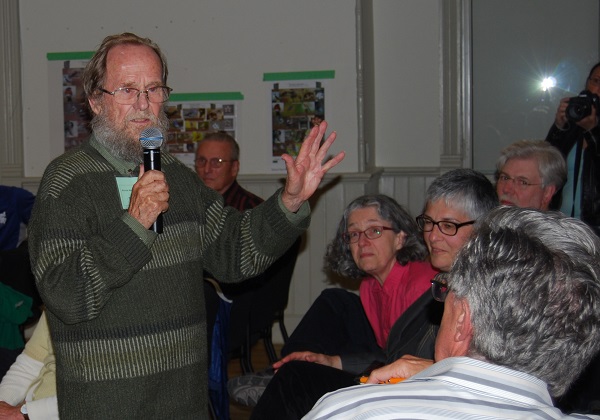 By Brock Weir A team of dedicated humans will be needed to give birds, reptiles and other critters a hand-up if Aurora's proposed Urban Wildlife Park gets off the ground by 2017. That was the message landscape architect David Tomlinson delivered to a standing-room-only crowd at the Aurora Cultural Centre last week in an information session dedicated to the local wildlife park. Slated for construction on land roughly bordered by St. John's Sideroad and Wellington Street in the north and south, and new and ongoing development in the east and west, proper management will be key to future success in the area, he said. “I think this nature reserve, when it is built, is going to be a really interesting thing because there are very, very few urban nature reserves,” said Mr. Tomlinson. “We have an enormous database of what was already in the reserve before all the housing was built so we can really start measuring what the real effect housing has been on the nature reserve and, even more importantly, the effect and efficiency of the management we carry out.” A haven of wetlands, grasslands, and various other types of habitat, Mr. Tomlinson has been keeping track of the impacts human development has had on the area for the past 20 years. Many of the ponds in the area, he said, have been constructed but left to their own devices have grown to support a wide diversity of wildlife. Certain ponds used to dry out efficiently during the warm summer months, creating huge swaths of mud that attracted arctic shorebirds on their migration. Developers in the area have since moved the dam that made this possible, allowing the mud to dry out fully, but proper management of water levels are just one of the many ways these lands can be restored to their former glory. “It is no good having ponds if you don't manage them, and that is the whole point of this nature reserve,” said Mr. Tomlinson. “It is not creating the nature reserve that is important, it is managing it and at least every seven to eight years, all the ponds should be drained in mid-July when most of the birds are finished nesting, and the sun bakes them up. That releases all the nutrients that have been trapped in the mud and the next year growth is really lush. “You have to be able to drain a pond to make it work. It is no good having ponds constructed that you can't drain. You have to be able to manipulate the levels in every wetland if it is going to be managed successfully.” Another important component of managing the area, is managing impacts the public at large might have on an area when it is complete and ready to open to visitors. Bird blinds are essential, he said, to allow spectators to take in the wildlife without infringing on their natural behaviours or, of course, scaring them away, as are clearly defined trails to keep people where they need – and should – be. Boardwalks were originally proposed for the Urban Nature Reserve, but in Mr. Tomlinson's opinion, hard, permeable trails and causeways would be cheaper and more efficient to maintain, as well as allowing for flood control. It is important to note how much water is flowing in and out of the area, and without this data it will be nearly impossible to properly manage the area. According to Mr. Tomlinson, the future Urban Wildlife Park needs to be properly wardened and the best way to do that is enlist the help of those people who would otherwise be walking their dogs along the trails. They would be able to keep an eye on the park as a whole, vandalism, and lay the foundation for keen groups of citizen volunteers, citizen scientists, and supporters that will ensure the park's future. Citizen volunteers would be able to control the water flows in the area, plant trees and shrubs, carry out small-scale habitat improvement, and create “microhabitats” like woodpiles to help species thrive. Citizen scientists would take out more specialised work, such as monitoring species and the success of habitat improvements, and helping re-introduce species that have been lost since development commenced in the area. “Developers argued there wouldn't be a loss of species, but there would be some reductions in populations,” said Mr. Tomlinson. “I might lose battles, but I do not lose wars. I decided once and for all I would settle this point so for the last 20 years, every Sunday at dawn, I have gone there and plotted every bird I had seen on the map once a week.” In the end, development has been “disastrous” to 15 species which have been totally lost, had an adverse effect on 23, marginal impacts on 11 species, smaller groups of species that initially thrived in human development before dropping off, and species like mallard ducks and robins that have thrived in the urbanized development. There is no reason to believe these species could not rebound through habitat restoration and reintroduction of species, he added. All this will, of course, come at a cost, particularly for landscaping and, to that end, Mr. Tomlinson proposes a creative way to keep some of those costs down – by introducing a species a bit more foreign to the landscape. “It is very important we protect the grasslands, but the only problem with grasslands are they are more expensive to maintain than woodlots,” he said. “The answer is to graze them and that is how these grasslands were originally maintained. You might think that grazing animals in an urban area is not a good idea, but grazing is an incredibly cheap way of managing and grazing grassland. “The best way would be to turn it over to urban farming people in the Town of Aurora in the spring, put money into a kitty, buy six cows at auction, ship them to the nature reserve, turn them loose, the cows can graze all summer free of charge, and all you have to do is put a few salt licks in.” Following the formal part of the meeting, Councillor Wendy Gaertner asked the all-important question of what to do with the cattle during the winter. Mr. Tomlinson's response? Ribfest. “I honestly believe that the best way to protecting wildlife in any country in the world is if local people look after their local wildlife,” he concluded. “You can't worry about [nature] in Africa, but you can worry about what happens on your doorstep. If every Town in Ontario did this, it would do more to improve the number and diversity of wildlife than any single factor.” |
| Excerpt: A team of dedicated humans will be needed to give birds, reptiles and other critters a hand-up if Aurora’s proposed Urban Wildlife Park gets off the ground by 2017. |
|
Post date: 2014-10-08 13:07:38 Post date GMT: 2014-10-08 17:07:38 Post modified date: 2014-10-15 13:02:45 Post modified date GMT: 2014-10-15 17:02:45 |
| Powered by [ Universal Post Manager ] plugin. HTML saving format developed by gVectors Team www.gVectors.com |